
Selecting optical filters for machine vision applications

Machine vision systems are expected to deliver reliable, repeatable results, whether they are inspecting components on a production line, guiding autonomous equipment, or supporting automated optical inspection (AOI). While cameras and lenses are often the primary focus during system design, optical filters can have an equally important impact on image quality and detection accuracy.
By controlling the wavelengths reaching the image sensor, optical filters can help reduce interference from ambient light and improve image contrast. Choosing the right filter depends on the application, illumination source, and imaging requirements.
Why optical filters matter in machine vision
Unwanted light is one of the most common causes of reduced image quality in machine vision systems. Ambient lighting, reflections from shiny surfaces, and stray wavelengths from illumination sources can all reduce contrast and make image processing more difficult.
We use optical filters to isolate the spectral range needed for the application. In machine vision applications, this can improve image consistency and reduce the impact of ambient lighting and reflections on inspection results.
Understanding filter types
Different machine vision applications require different approaches to light management. The most suitable filter will depend on the illumination source, sensor characteristics, and the spectral requirements of the system.
 Dichroic filters
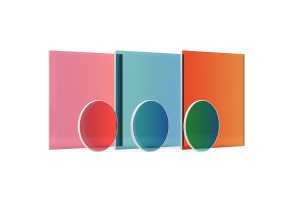
Dichroic filters use specialised optical coatings to transmit selected wavelengths while reflecting others. Unlike absorptive filters, unwanted wavelengths are reflected rather than absorbed.
We offer custom dichroic filter solutions, including shortpass, longpass, and bandpass designs. These can be tailored to specific wavelength requirements, making them useful in machine vision systems where particular wavelength ranges need to be separated or controlled.
IR cut filters
Many image sensors are sensitive to near-infrared (NIR) light as well as visible wavelengths. Without filtering, this additional infrared response can affect colour accuracy and image reproduction.
IR cut filters are designed to block near-infrared wavelengths while transmitting visible light, helping to maintain true colour imaging. They are commonly used in colour camera systems where accurate colour representation is important.
 Interference bandpass filters
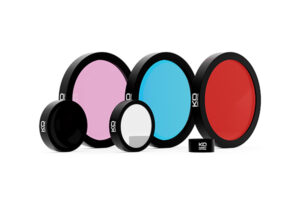
Interference bandpass filters are designed to transmit a defined spectral band while providing high levels of blocking outside the passband.
Available in narrowband and broadband configurations, they can help improve contrast and isolate the spectral region required for the application.
Key considerations when selecting a filter
1. Identify the wavelength of interest
Start by identifying the wavelengths required for the application. For some systems, this may involve visible imaging. Others may use ultraviolet or near-infrared wavelengths to enhance contrast or reveal features not visible under normal lighting conditions.
Our filter and coating capabilities support applications from UV through to SWIR wavelengths, allowing us to provide solutions for a wide range of imaging systems.
2. Evaluate transmission performance
A filter should efficiently transmit the wavelengths required by the sensor. Insufficient transmission can reduce signal strength and affect image quality, particularly in applications where available light is limited.
Designers should evaluate both peak transmission levels and transmission across the required wavelength range.
3. Review blocking requirements
Blocking performance is often as important as transmission performance. A filter may need to reject ambient light, reflections, or wavelengths generated by external light sources.
The operating environment often determines the level of blocking required. Systems operating in brightly lit manufacturing environments may have different requirements from those using controlled illumination.
4. Assess the complete optical system
Optical filters do not operate in isolation. Performance is influenced by the camera sensor, imaging lens, illumination source, and optical coatings used throughout the system.
Filters should be specified as part of the overall optical system rather than as standalone components. Changes to the illumination source, imaging lens, or sensor can all influence the filter requirements.
Optical filters in automated inspection
Automated Optical Inspection (AOI)
AOI systems rely on consistent image data for defect detection, assembly verification, and dimensional measurement. Filters can help reduce reflections and improve visibility of the features being inspected.
360° inspection systems
Multi-camera inspection systems depend on consistent performance across several viewing angles. Variations in lighting and reflections can affect inspection results. Consistent filtering across multiple cameras can help maintain uniform imaging throughout the system.
Autonomous Mobile Robots (AMRs)
Autonomous systems frequently operate under changing lighting conditions, both indoors and outdoors. Filtering can help maintain imaging performance as lighting conditions change.
LiDAR and sensor systems
The robotics and automation sector increasingly relies on optical sensing technologies, including LiDAR. Filter selection can play an important role in managing the wavelengths reaching imaging and sensing systems.
The role of optical coatings
Many optical filters rely on precision coatings to achieve their transmission and blocking characteristics.
We offer optical coating solutions including antireflection (AR), dichroic, beamsplitter, and linear variable filter coatings. These capabilities are supported by thermal evaporation, e-beam evaporation, magnetron sputtering, and ion beam sputtering (IBS) technologies.
The coating specification can significantly influence the performance of the final filter.
Conclusion
Selecting the right filter requires an understanding of the application, illumination conditions, sensor characteristics, and overall optical system. Factors such as transmission, blocking performance, filter type, and coating technology all influence the final specification.
We supply a range of stock and custom optical filters supported by extensive coating capabilities and in-house testing. If you’d like assistance selecting a suitable filter for your machine vision application, contact our technical sales team at [email protected].