
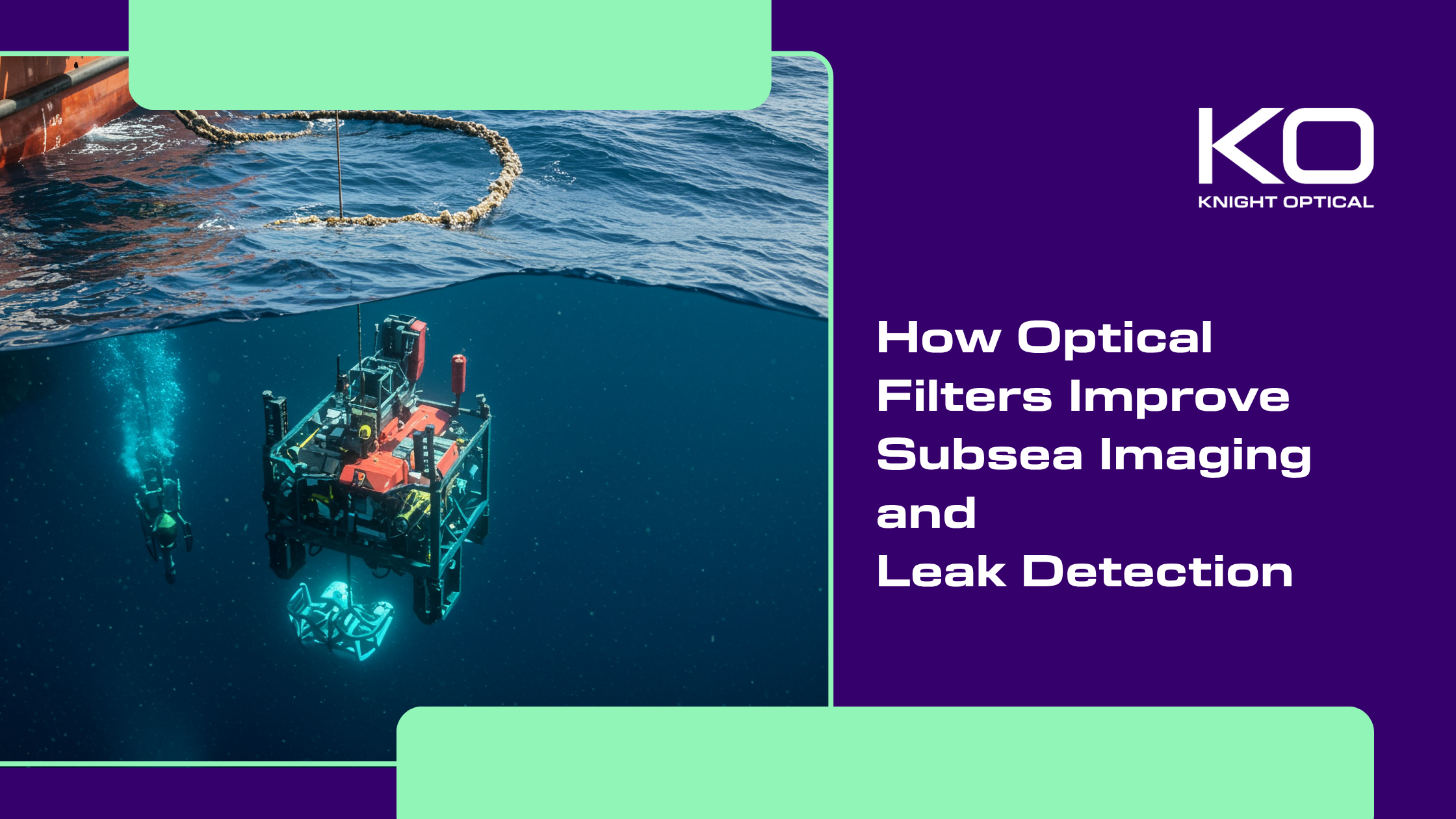

How optical filters improve subsea 3D imaging and leak detection performance
Subsea imaging systems operate in challenging environments where water conditions, pressure and salinity can all affect imaging performance. Water absorbs and scatters light, while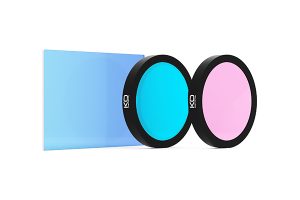 pressure and salinity place additional demands on optical and mechanical components. At the same time, applications such as 3D surveying and hydrocarbon leak detection require high levels of accuracy and reliability.
Optical filters play an important role in determining image quality, measurement accuracy and detection performance.
The challenges of subsea imaging
Light propagation in water differs significantly from propagation in air, introducing several effects that can reduce image quality and measurement accuracy.
- Light absorption in water: Water absorbs light unevenly across the spectrum: red wavelengths are absorbed fastest, followed by the rest of the visible spectrum, with blue-green light penetrating furthest. The result is a natural colour shift that gets worse with depth. For this reason, many subsea imaging systems operate within the blue-green region of the spectrum, where water transmission is relatively high.
- Scattering and backscatter: Suspended particles scatter light back toward the camera before it even reaches the subject, producing the hazy, low contrast look familiar from underwater footage. This is often worse when artificial illumination is added, since the light source itself becomes a scattering source.
- Reduced contrast and colour fidelity: Between absorption and scattering, images lose both the contrast and the colour accuracy needed for reliable inspection or measurement work.
- Difficulty maintaining accurate 3D measurements: For 3D imaging and survey applications, scattering and refractive effects introduce noise and distortion that can compromise measurement accuracy and 3D reconstruction fidelity. In laser-based 3D imaging systems, narrow bandpass filters are often matched to the illumination wavelength, helping reject ambient and backscattered light while improving measurement accuracy.
Watch: The Optics of Autonomous Underwater Vehicles (AUVs)
Why optical filters matter underwater
Optical filters address these challenges by controlling which wavelengths reach the sensor.
In subsea imaging systems, optical filtering can:
- Improve signal-to-noise ratio by excluding wavelengths that contribute more to scattering and background noise than useful signal.
- Enhance image contrast and colour fidelity by transmitting wavelength bands most relevant to the imaging task.
- Support reliable detection and analysis by preventing unwanted out-of-band light from reaching the sensor.
Optical filters used in subsea 3D imaging
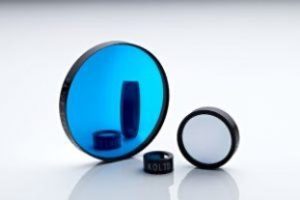
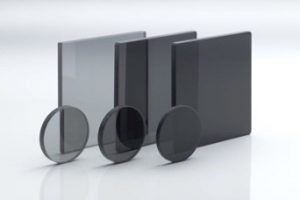
Different filter types serve different roles within a subsea imaging system:
 |
|
 |
|
 |
|
 |
|
Managing thermal load in illuminated systems
In illuminated subsea imaging systems, particularly those using high-power light sources, infrared (IR) radiation can introduce unnecessary thermal loading within the optical assembly.
Hot mirrors can be used to reflect IR wavelengths while transmitting visible light, helping reduce heat reaching downstream optical and detector components.
Cold mirrors perform the opposite function, reflecting visible wavelengths while transmitting IR radiation away from the illumination path.
Optical filters for underwater leak detection
Leak detection is one of the most demanding applications of subsea optical filtering. Detecting hydrocarbons (oil, gas and related compounds) relies on their characteristic spectral signatures at specific infrared wavelengths. Optical filters isolate these wavelengths to improve distinction between hydrocarbons and the surrounding underwater environment.
- SWIR and MWIR applications: SWIR and MWIR wavelengths are commonly used for hydrocarbon detection, but filter selection must also account for the strong wavelength-dependent absorption of water. The most effective spectral bands balance hydrocarbon contrast with the transmission characteristics of the underwater environment.
- Spectral filtering for enhanced detection sensitivity: Filter centre wavelength and bandwidth must be carefully optimised to maximise spectral contrast between hydrocarbons and the surrounding environment while maintaining sufficient signal strength.
- Multi-band detection approaches: Many subsea monitoring systems use multiple filters to compare different wavelength bands, helping distinguish hydrocarbons from the surrounding environment and reducing false positives.
Choosing the right filter for subsea applications
When specifying filters for subsea use, there are several considerations beyond the usual optical requirements:
- Wavelength: The exact band needs to match both the imaging requirement and, for leak detection, the absorption characteristics of the target compound.
- Transmission requirements: Sufficient transmission across the relevant band is critical when working with the low light levels typical of subsea environments.
- Environmental durability: Materials, coatings and substrates must withstand prolonged saltwater exposure and resist corrosion or performance degradation throughout the intended deployment period.
- Pressure resistance: Depending on operating depth, filters and their mounts must withstand significant pressure without deforming or compromising optical performance.
- Angle of incidence (AOI): Filter performance can change with angle of incidence, particularly for interference-based coatings. Systems operating off-axis or at fixed illumination geometries should ensure the specified spectral performance is achieved at the intended operating angle.
Getting the specification right
Subsea imaging and leak detection systems place demanding requirements on optical filters.
Achieving reliable performance requires careful consideration of wavelength range, spectral bandwidth, substrate selection, angle of incidence, environmental durability and operating depth.
We supply both stock and custom optical filters, including bandpass, longpass, shortpass, neutral density, hot mirror and cold mirror designs, with substrate and coating options tailored to demanding subsea environments.
Contact our technical sales team today to discuss your optical filter requirements.