

Optical bandpass filters are a cornerstone component in many optical and photonic systems. Designed to transmit a defined range of wavelengths while blocking light outside that range, they enable precise spectral control where accuracy, repeatability and signal clarity matter most.
From laboratory instrumentation to machine vision and sensing applications, bandpass filters help ensure that optical systems see only what they are meant to see and nothing more.
What is an optical bandpass filter?
An optical bandpass filter is a type of interference filter that selectively transmits light within a specified wavelength band, known as the passband, while rejecting shorter and longer wavelengths. This behaviour is achieved through multilayer thin film coatings deposited onto an optical substrate.
Unlike absorptive coloured glass filters, interference bandpass filters rely on constructive and destructive interference between reflected light waves. This allows for:
- Sharply defined wavelength cut on and cut off regions
- High transmission within the passband
- Strong blocking outside the passband
The result is precise spectral performance with minimal signal loss.
How optical bandpass filters work
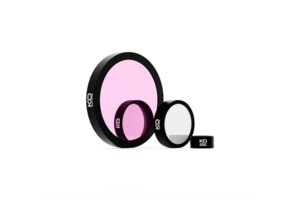 A bandpass filter typically consists of alternating layers of materials with different refractive indices. The thickness and sequence of these layers are engineered so that only light within a specific wavelength range constructively interferes and is transmitted.Light outside the designed band undergoes destructive interference and is reflected or blocked. By adjusting the coating design, manufacturers can tightly control the centre wavelength, bandwidth and blocking performance of the filter.
Key performance parameters
When specifying an optical bandpass filter, several parameters define its suitability for an application:
Centre wavelength (CWL)
The midpoint of the transmitted wavelength band. This is selected based on the light source, detector sensitivity or target spectral feature.
Bandwidth (FWHM)
Defined as the full width at half maximum transmission. Narrow bandwidths offer greater spectral selectivity, while wider bandwidths allow higher signal throughput.
Peak transmission
The maximum transmission achieved within the passband. High peak transmission improves signal to noise ratio.
Out-of-band blocking
The filter’s ability to suppress unwanted wavelengths outside the passband, typically expressed as optical density.
Angle of incidence sensitivity
As the angle of incoming light increases, the passband can shift. This is an important consideration in systems with non-collimated light.
Where optical bandpass filters are used
Optical bandpass filters are widely used across photonics and optical engineering applications, including:
- Machine vision and imaging systems
- Fluorescence microscopy and life sciences
- Spectroscopy and analytical instrumentation
- Laser based systems and sensing
- Industrial inspection and automation
In each case, the filter’s role is to isolate relevant spectral information and reduce noise from ambient or unwanted light sources.
Benefits of using optical bandpass filters
Correctly specified bandpass filters deliver several system level advantages:
- Improved contrast and image clarity
- More stable and repeatable measurements
- Reduced sensitivity to ambient lighting changes
- Enhanced detection of spectral features
- Simplified downstream signal processing
Engineers often find that solving spectral challenges optically leads to more robust and efficient system design overall.
Optical bandpass filters from Knight Optical
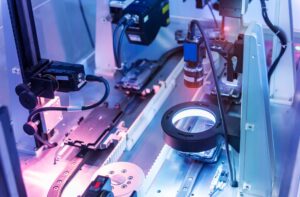 Knight Optical offers a comprehensive range of optical bandpass filters, including stock interference filters covering common wavelengths used in industrial, scientific and machine vision applications.
Filters are available with a variety of centre wavelengths and bandwidths, and custom solutions can be supported for applications requiring tighter tolerances or specific blocking requirements.
If you want to bring order to an unruly optical signal, an optical bandpass filter is often the quiet hero doing the heavy lifting. Precise, dependable and refreshingly logical, exactly how engineers like their optics.