
Nephelometry plays a significant role in keeping us protected from airborne and waterborne contaminants. An instrument used to measure particulate matter by examining scattered or transmitted light in air and liquid samples, the accuracy of a nephelometer’s results is highly dependent on the optics integrated into its design. From aspheric lenses to bandpass filters, we look at what goes inside a nephelometer’s optical train and why component specifications matter.
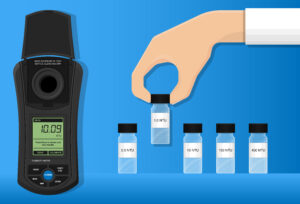
Whether assessing drug formulations and solubility in a pharmaceutical lab, ensuring drinking water is safe to consume at a water treatment plant, or conducting air quality measurements on a factory floor, nephelometry is a common technique for detecting particulate contaminants with utmost accuracy.
How Nephelometers Measure Transmitted & Scattered Light
Nephelometers work by directing light into a chamber and analysing how it interacts with the sample. In turn, readings reveal the physical characteristics of particulates present in a specimen.
There are two primary methods of analysis: light scattering from particles captured via nephelometric detection and the assessment of light blocked – or absorbed – by particulates, referred to as turbidimetry.
The key difference is:
- Nephelometry: Placed at a 90º angle to the incident light beam, nephelometers pick up the intensity of light scattering. The higher the concentration of particulate matter, the stronger the scattering of light recorded.
- Turbidimetry: Located directly opposite (in line with) the beam, a turbidimeter measures the degree of light attenuation. In turbidimetry, the dimmer the signal, the greater the concentration of particulate contaminants detected.
The Anatomy of Nephelometric Detection: Optical Components & Their Functions
The optical components within nephelometers play three key roles: isolate, direct and collect light to identify particulate contaminants, many of which are invisible to the naked eye.
From a focusing lens for optical scattering to a protective window, this is achieved through a series of high-spec components, such as:
Optical Lenses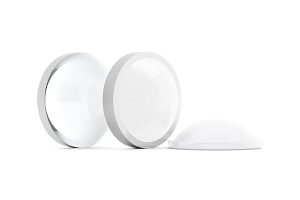
Integral to focusing and collimating light from a source into a sample chamber, collimating lenses for nephelometers make sure a controlled, uniform light path reaches the specimen for accurate particle analysis.
To improve performance and reduce spherical aberration – which can impede findings – aspheric lenses are commonly employed in these setups, especially in laser nephelometers, where laser diode sources demand enhanced beam control and precision.
In nephelometry, poor lens quality can result in unfocused beams, leading to inaccurate particle-size data, unreliable turbidity measurements, and skewed scattering coefficients.
 Bandpass Filters
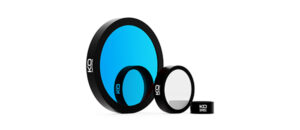
Used as an optical wavelength filter for scattering, bandpass filters selectively transmit the system’s designated wavelength, so noise generated by other spectral bands doesn’t compromise the analysis of scattering particles. Every bandpass filter nephelometers use must be precisely matched to the specific spectral band being targeted.
 IR-Cut Filters
IR-cut filters ensure measurement integrity by blocking stray near-infrared (NIR) light before it reaches the detector, which could otherwise be mistaken for particle scattering. This ensures only the target frequency is measured.
Optical Windows
Positioned at the entry and exit points of a sample chamber, optical windows protect the device against damage.
In nephelometry, material specification matters, with substrates offering minimal absorption required to avoid interference with scattering properties. As such, quartz and N-BK7 are often used due to high transmission.
Mirrors & Prisms
Mirrors and prisms are usually incorporated within larger-scale setups. While mirrors redirect reflected light within a system, prisms steer beams along complex optical paths, enabling more compact instrument dimensions.
To find out more about precision optics for nephelometers and other optical particle sensors, or to browse our stock components available to order now, please use the buttons below.