
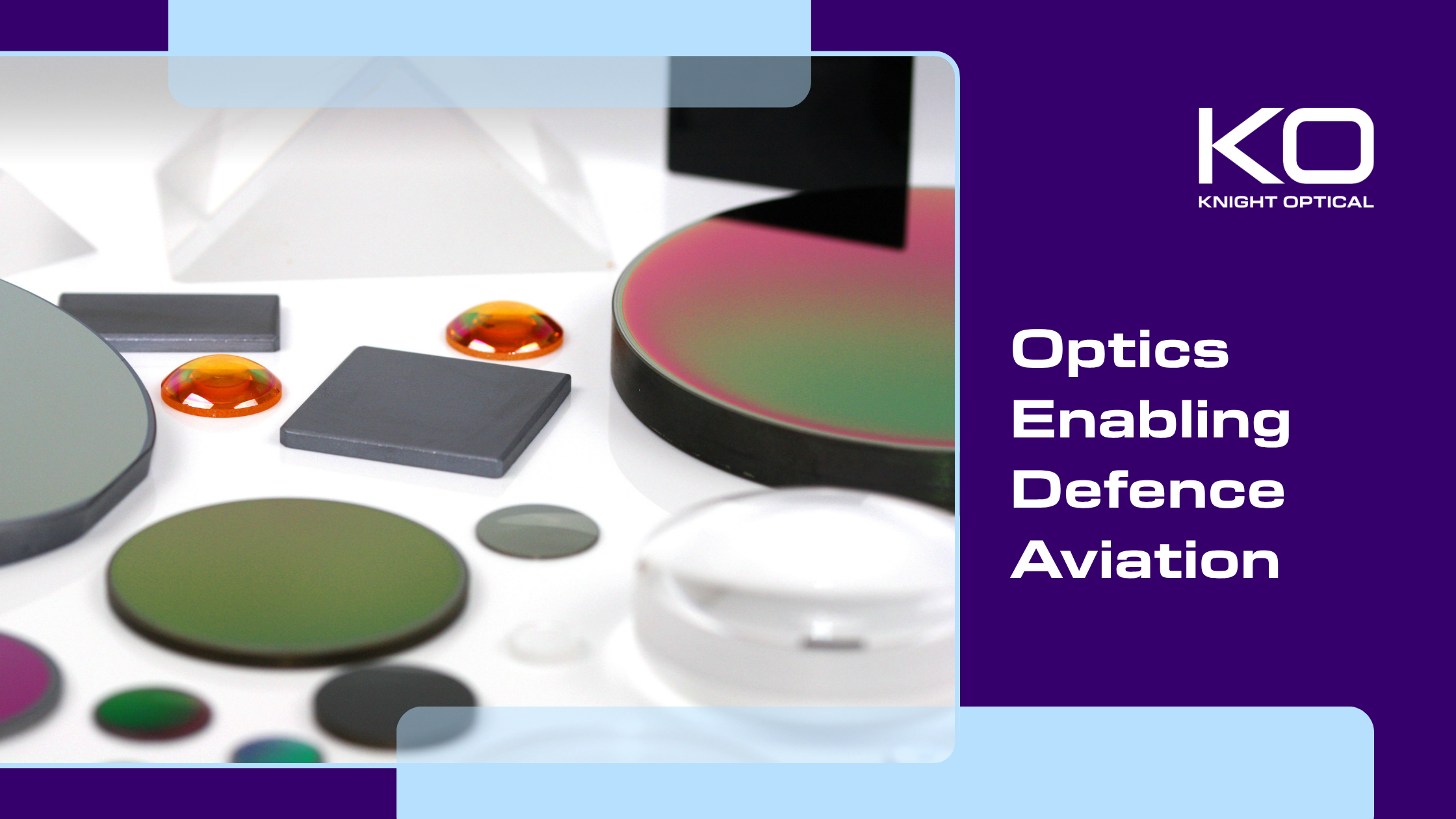

Optics That Enable Navigation, Guidance & Safety Systems in Defence Aviation
For defence-aviation optics, failure isn’t an option. The sensing and imaging used to guide aircraft safety systems, navigation sensors and situational awareness rest on how optical components are specified, and getting it wrong can result in inaccurate data, compromised architectures, and a lost mission.
Sensing the Operating Environment
Airborne optical components must withstand the vibration, altitude, and thermal extremes of every deployment, but they also need to deliver strong transmission, wavefront accuracy and dimensional stability for a system to perform, and that stems from the components themselves.
In such mission-critical platforms, consistent sensing begins by protecting the core hardware from its immediate surroundings. Infrared (IR) optical windows, such as those used for thermal imaging, forward-looking infrared (FLIR) and other electro-optical (EO)/IR systems, serve as the barrier between the sensor and the external environment. If they aren’t correctly specified, with poor transmission characteristics or inappropriate substrates and coatings, unwanted spectral bands may reach the detector, increasing noise and reducing image quality. Behind these windows, ruggedised lenses that focus the incoming IR waveband toward the detector demand equal consideration, especially around heat. Temperature swings at altitude can shift the focal point due to thermal expansion and changes in refractive index, which are commonly mitigated through athermal optical design or active focus compensation.
Alongside temperature-sensitive challenges, navigation, guidance, and safety system sensors widely operate in low light and, in certain cases, total darkness. Night-time navigation regularly relies on image-intensified night vision, using visible (VIS)/near-infrared (NIR) optical assemblies and thermal/FLIR technologies working in the mid-wave infrared (MWIR) and long-wave infrared (LWIR). Because the two operate in separate wavelength bands, they generally require distinct optical materials. While MWIR and LWIR platforms often employ materials such as germanium, chalcogenides, silicon and zinc selenide, VIS and NIR systems usually use optical glass such as N-BK7, sapphire, and fused silica.
Optical innovations are increasingly helping with operational awareness, collision avoidance, terrain recognition, and environmental monitoring. Here, EO and IR sensors underpin 360º situational awareness, sense-and-avoid on unmanned vehicles, and synthetic or enhanced vision that reconstructs terrain in zero-visibility situations. Light detection and ranging (LiDAR) and multispectral imaging (MSI) each use their own application-specific optics for environmental sensing, atmospheric characterisation, hazard identification, and, in some applications, can help detect and assess ice conditions too.
Splitting Light Across Sensors & the Cockpit
In multi-imaging payloads, the same scene often needs to be captured simultaneously in multiple ways. Splitting light allows a single shared aperture to route the scene to several sensors, each capturing a different wavelength range, while meeting size, weight, and power (SWaP) constraints; for instance, fusing VIS and IR imagery to combine fine detail with heat signature.
This is typically achieved by beamsplitters, dichroic mirrors, and prisms that divide the incoming beam, with dichroic optics doing so by waveband and partially reflective beamsplitters according to reflect/transmit (R/T) ratios, sending individual parts to their own sensors. It’s important for this split to be spectrally clean; a dichroic that bleeds the incorrect band into the wrong sensor or a beamsplitter with an off-spec R/T ratio or inadequate wavefront degrades registration across channels, meaning that component-level specification, not just software-based calibration, determines image quality.
Heads-up displays (HUDs) and helmet-mounted displays (HMDs) rely on the same principle, using beam combiners to overlay symbology onto the pilot’s viewing area. In this context, a combiner’s coating performance, R/T properties and wavefront quality all contribute to image clarity and alignment, ensuring the operator sees clear overlaid information without distorting the view of the outside world.
Substrates, Coatings & Specification
SWaP limits also favour lower-mass substrates, such as fused silica for broadband windows and lenses, and sapphire, where exposed surfaces must resist abrasion. Coatings, in turn, maximise transmission and protection. Anti-reflective (AR) coatings suppress ghosting and stray light, while diamond-like carbon (DLC) coatings are frequently applied to germanium and silicon optics to improve durability against rain erosion, sand abrasion and other external hazards.
An Optical Component Supplier for Demanding Conditions
Built and metrology-tested for high-vibration, high-altitude and high-thermal-load conditions, our stock and custom optical components are engineered and verified to support reliable functionality in navigation, guidance and safety systems.
To discuss your optical specifications for aviation or aerospace environments, contact a member of our team today.