

Whether it’s helping fighter pilots track targets and navigate hostile skies or guiding commercial airliners through low-visibility approaches, head-up displays – also known as a heads-up display or HUD – have been fundamental to aerospace safety for decades and are recognised as an early variant of augmented reality (AR). Projecting vital flight information directly toward a pilot’s line of sight without requiring them to look down, there’s an array of high-precision optical components behind every system. Here, we explore suitable optics that make aerospace HUD technology possible.
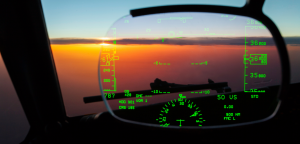
Car manufacturers like BMW, Mercedes-Benz, Audi and Mazda commonly integrate HUDs as a premium automotive display for navigation aid and to avoid driver distraction. But the innovation originated in the military aerospace industry, where it continues to play an essential role in avionic displays. It’s within this sector that the most advanced optical engineering takes place, with boundaries being pushed in terms of full-colour displays, wider fields of view (FoV) and holographic optical elements (HOEs).
How Do Head-Up Displays Work?
HUDs are similar to mini movie projectors. Flight data from the aircraft’s computer system is projected onto a transparent screen, known as a combiner – typically a piece of glass, a specially coated section of windscreen (windshield HUD) or even helmet-mounted displays (HMDs) – and then reflected toward the user’s FoV.
But, unlike a cinema projector, HUDs use a combination of standard projection and specialised collimating optics to generate an image that appears at what’s called ‘optical infinity’. Put simply, this means the display looks as though it’s far in the distance, but in reality, it’s just a few centimetres away.
This distinct effect has major benefits. Allowing pilots to view key data while their eyes simultaneously remain focused on the distant horizon or runway, HUDs remove the need to refocus their vision.
How Optics Work in Aerospace Head-Up Displays
Optical components facilitate a very specific light journey that makes HUDs function and deliver high image quality. It starts with a micro-display – usually an LCD, LED or OLED screen – that generates the flight data imagery. From there, projection optics magnify and shape this virtual image into something an operator can read quickly.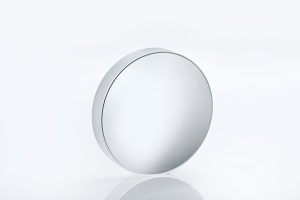
Next, collimation optics produce a unique phenomenon. Specialised lenses or Concave Mirrors transform diverging light rays (from the projection optics) into parallel beams, creating optical infinity.
In many aircraft HUDs, fold mirrors are utilised, too. In this configuration, they redirect the light path, forming a zigzag structure throughout the assembly to keep the footprint of the device compact.
Finally, light hits a beamsplitter (or combiner glass), often coated in dichroic or interference coatings for single-colour setups or broadband coatings for full-colour designs.
Together, these optics and coatings reflect visuals to the pilot’s FoV, while remaining transparent to the outside world.
4 Types of Optical Components Used in Avionic Head-Up Displays
1. Projection Lenses
HUDs incorporate several lens types. Relay varieties transfer the image, while field lenses control illumination and objective components provide magnification. A selection of optics can form this setup – from Planoconvex and Biconvex to Aspheric Lenses.
At Knight Optical, we offer an array of precision lenses for HUD applications, with bespoke substrates available to fulfil specific thermal stability requirements and dimensional criteria.
2. Collimation Optics
Collimation needs specific optics to convert diverging light into parallel beams. Planoconvex and Aspheric Lenses are popular, with aspherics offering superior performance by minimising spherical aberration. For full-colour HUDs, Achromatic Lenses help correct chromatic aberration across different wavelengths. An alternative beyond the lens family, Concave Mirrors reflect and collimate light in a single component.
Surface quality and focal precision are critical for collimation optics. Our fully-equipped metrology lab ensures each one meets the tight tolerances demanded for aerospace HUD systems.
3. Beamsplitters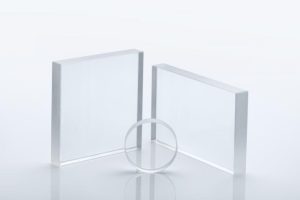
The beamsplitter redirects projected imagery to the user’s FoV. Plate Beamsplitters specifically dominate the market, normally featuring thin-film dichroic coatings that selectively reflect narrow wavelength bands (typically 530-570nm for monochromatic green displays). Meanwhile, broadband coatings enable full-colour displays by reflecting multiple spectral ranges at the same time.
We supply custom coatings that ensure durability under the harsh conditions of military and commercial flight operations.
4. Fold Mirrors
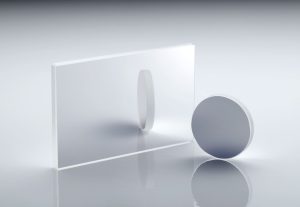 Similar to beamsplitters, fold mirrors are employed to minimise the footprint of a HUD. Essentially, fold mirrors are flat plane mirrors that have been configured to redirect a light path, producing that zigzag formation that keeps devices compact.
Cold Mirrors are frequently brought in to help reduce device size, too. A specialised optic, these are dichroic-coated components that reflect visible spectral ranges (400-700nm) while transmitting infrared (IR), which helps to prevent heat build-up in assemblies.
Our portfolio includes a variety of plane mirrors appropriate for fold mirror arrangements, alongside Cold Mirrors for thermal management in sealed HUD assemblies.
What to Consider When Choosing Suitable Optics for Head-Up Displays
From lenses and mirrors to beamsplitters, every component in a HUD system must meet stringent aerospace specifications to ensure pilot safety in demanding environments and enable optimal performance.
At Knight Optical, we provide high-precision optics to MIL-SPEC standards, delivering the excellence and reliability that defence and aerospace applications demand.
To learn more about our entire range of optical components for HUD systems or to discuss custom solutions, contact a member of our technical sales team today.