
Earth observation satellite optics: key components and design considerations

Earth observation satellites all perform the same task: collecting light from the Earth’s surface and delivering it to a detector. The optical payload is responsible for gathering, directing and filtering that light while maintaining image quality throughout the mission.
Payloads used for environmental monitoring, mapping, surveillance and remote sensing typically combine mirrors, windows and filters within a compact optical system designed to survive launch and operate reliably in low Earth orbit.

Why mirrors dominate Earth observation systems
Most Earth observation telescopes use reflective optics rather than lens-based designs.
Mirrors operate across a broad wavelength range and avoid chromatic aberration, making them suitable for systems working in visible, near infrared and infrared wavebands. Reflective optical layouts also allow long focal lengths to be folded into compact payload volumes.
Common mirror types include front surface mirrors, laser mirrors, hot mirrors, cold mirrors and custom optical mirrors.
Fold mirrors and beam steering
Payload volume is often one of the main constraints in satellite optical design.
Fold mirrors redirect the optical path through the instrument, allowing longer focal lengths to fit within a compact housing. Beam steering mirrors redirect light within the optical system and can be used to compensate for pointing errors, maintain alignment or control the line of sight.
Instruments designed for CubeSat and small satellite platforms often rely on multiple mirror surfaces to deliver the required optical path length within a restricted volume.
Off-Axis Parabolic mirrors
Off-axis Parabolic (OAP) mirrors focus or collimate light without introducing spherical aberration while maintaining an unobstructed beam path.
They are frequently used in compact imaging systems, spectrometers and other optical instruments where optical performance and packaging constraints must be balanced.
Windows and protective optics
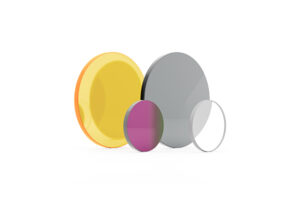
Optical windows protect detectors and internal optical components while transmitting the required wavelengths.
Common infrared window materials include sapphire, silicon, zinc selenide and calcium fluoride. Material selection is determined by the operating wavelength range, environmental conditions and optical requirements of the system.
Surface quality, flatness, coatings and dimensional tolerances can be just as important as substrate choice when specifying a window for space-based applications.
Read more: IR window materials compared
Filters and spectral selection
Earth observation instruments often operate within specific wavelength bands rather than across the entire spectrum.
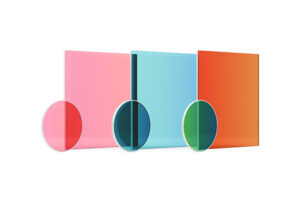
Optical filters transmit selected wavelengths while blocking others, allowing imaging systems to isolate spectral information relevant to a particular measurement. Multispectral and hyperspectral payloads both rely on optical filtering to separate and analyse incoming light.
Coatings across the optical path
Anti-reflective coatings are commonly used on windows and filters to maximise transmission. Reflective coatings are used on mirrors to achieve the required performance across specific wavelength ranges.
Additional coatings, including diamond-like carbon (DLC), may be applied where increased durability is required.
Optical design challenges in CubeSats
CubeSat payloads place strict limits on size, weight and available volume.
Folded optical paths, precision mirrors, optical windows, filters and coatings all contribute to achieving the required imaging performance within these constraints. Design decisions often involve balancing focal length, field of view, optical throughput and packaging requirements.
Watch: The Optics of Earth Observation Systems
Optical components for Earth observation systems
Mirrors, windows and filters each perform a specific function within an Earth observation payload. The performance of the overall instrument depends on how effectively those components work together.
At Knight Optical, we support space and aerospace projects with stock and custom optical components for visible and infrared applications, including mirrors, windows, filters and coated optics.
Visit us at Space Tech Expo Europe, 17-19 November, Hall 7, Stand Z35, or contact our team at [email protected] to discuss your project.
Request a quote or email our technical sales team: [email protected].