
Reticle vs Graticule vs Photomask: What’s the difference?

Ask three engineers to identify a patterned piece of glass and you may get three different answers. A defence engineer might call it a reticle. A microscopist might call it a graticule. A semiconductor engineer may use the term photomask or reticle, depending on the application.
The terminology varies between industries, but understanding the differences can help when specifying or sourcing a component.
Why are there different names?
These terms developed in different industries, often describing similar technologies used for different purposes.
In optics, defence and imaging systems, reticle is the most common term. In microscopy and metrology, graticule is often preferred. In semiconductor manufacturing, photomask and reticle are used for patterning tools rather than viewing components.
The same component may be described differently depending on the industry.
What is a reticle?
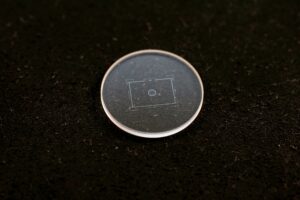 A reticle is a patterned optical component placed within an optical system to provide a visual reference.
Reticles are used in optical sights, telescopes, imaging systems, alignment equipment and measurement instruments.
Common patterns include:
- Crosshairs
- Measuring scales
- Alignment marks
- Targeting references
- Ranging patterns
Reticles are designed to be viewed, either by an operator or by a detector within the system.
You may also encounter the spelling reticule. In optics, reticle and reticule are generally used to describe the same type of component and there is no technical distinction between the two terms.
What is a graticule?
A graticule is a patterned optical component used for measurement, alignment or calibration within an optical instrument.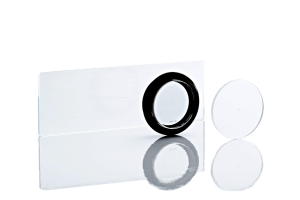
The term is particularly common in microscopy, metrology and inspection systems.
Typical examples include:
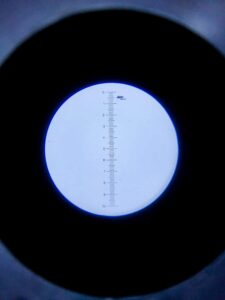
- Eyepiece scales
- Calibration grids
- Measuring references
- Crosshairs
In most cases, the choice between reticle and graticule reflects industry convention rather than any difference in manufacture or function.
A microscope graticule and a sighting reticle may be manufactured using the same processes on the same substrates while being described differently by their users.
What is a photomask?
A photomask serves a different purpose.
Rather than being viewed within an optical instrument, a photomask is used during photolithography to transfer a pattern onto another surface.
Photomasks are used in:
- Semiconductor manufacturing
- MEMS fabrication
- Photonics manufacturing
- Microelectronics production
- Microfluidic device fabrication
The pattern carried by the photomask is transferred into photoresist and ultimately onto a wafer or substrate during manufacturing.
Unlike reticles and graticules, photomasks function as manufacturing tools rather than visual references.
Why does semiconductor terminology become confusing?
 Semiconductor terminology uses the word reticle differently.
Historically, a photomask carried the pattern for an entire wafer at full scale. A reticle contained the pattern for a single exposure field, which was then reduced optically and repeated across the wafer during processing.
Modern semiconductor manufacturing often uses the terms mask and reticle interchangeably, even though the distinction originally described different types of lithography tooling. As a result, the word reticle may refer either to a viewing component in an optical instrument or to a patterning tool used during semiconductor manufacturing.
Reticle vs graticule
For most optical applications, reticle and graticule describe the same type of component.
Both:
- Sit within an optical system
- Provide a visual reference
- Can contain scales, crosshairs or alignment features
- Are manufactured using similar processes
Reticle is more common in defence, imaging and sighting systems, while graticule is more common in microscopy, metrology and inspection.
Reticle vs photomask
Reticles and photomasks perform different functions. A reticle is installed in an optical instrument and viewed throughout its service life, whereas a photomask is used to transfer a pattern during manufacturing and is not intended to be viewed by the end user. Although both are precision patterned optical components, they are specified differently.
Reticles are commonly specified according to:
- Visibility
- Contrast
- Line width
- Illumination requirements
Photomasks are commonly specified according to:
- Feature dimensions
- Placement accuracy
- Flatness
- Defect control
- Pattern transfer performance
Which term should you use?
 Most manufacturers understand the overlap between these terms, so using graticule when you mean reticle is unlikely to cause confusion.
A detailed specification is far more important than selecting the perfect term.
When making an enquiry, it helps to provide:
- A drawing or sketch
- Pattern dimensions
- Substrate size and material
- Required line widths
- Optical requirements
- Illumination conditions
- Environmental requirements
- Prototype or production quantities
This information provides a much clearer picture of the application than terminology alone.
Summary
In optics, reticle and graticule are often used to describe the same type of patterned optical component. Reticule is an alternative spelling that carries no technical distinction. Photomask typically refers to a component used for lithographic pattern transfer rather than direct viewing.
The intended application, operating environment and performance requirements will determine how the component should be manufactured and specified.
Knight Optical supplies stock and custom patterned optical components, including reticles, graticules and photolithography products. To discuss a requirement, contact the technical sales team: [email protected]