
Quality and durability are pivotal when specifying optical components. Yet, in the pioneering space sector, unique demands call for amplified precision. This is where working with a trusted optics supplier proves invaluable. Here, specialists from the Knight Optical team uncover why such partnerships matter and share their expertise on standards and the very specific testing procedures for optics in space applications.

Optics for Space Tech
Telescopes, spectrometers, interferometers and Satellite Laser Ranging (SLR) – without high-precision optical components, they wouldn’t give us the incredible insights we have into the universe. Take last month’s stunning conjunction of Venus dancing around the Moon, for example. Or our ability to understand the composition of planets and asteroids and pinpoint the positions of far-off stars. None of this would be achievable without the contribution of optics.
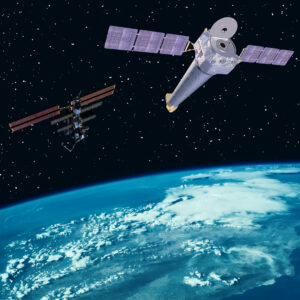
And that’s just the beginning. Spaceborne communication systems serve as the backbone of connection and data transfer for operating spacecraft, satellites, and space stations, as well as for relaying information back to Earth. Here, top-tier mirrors and lenses are key elements in systems’ payloads, facilitating high-speed communication.
LiDAR is another important technology. These setups, too, rely on a range of optics, including Lenses, Mirrors, Beamsplitters, Prisms, and Windows, to map planetary surfaces – like the Moon or Mars – and study ice sheets, forests, or ocean floors.
The crux of precision in these assemblies lies in their optics. So, with such a major role to play, what are the key factors to consider when selecting these components?
Standards & Testing
Testing and standards are a strong starting ground, as Metrology Supervisor, Nathan Cosbie‑Ross, elucidates: “Depending on the environment an optic is used in, standards can be very useful in offering a measure of guarantee that optics will survive the usage requirements.”
Choosing an optical component supplier with ISO 9001 and 14001 certifications and an in-house Metrology Laboratory provides a firm foundation. However, this is just the first step. To confirm optics meet stringent space parameters, it’s crucial that the provider can address project-specific benchmarks.
In the case of the space sector, these can include:
- MIL-PRF-13830B
- MIL-STD-810
- MIL-C-48497
- ECSS-Q-ST-70-17C
- First Article Inspection Report (FAIR)
“MIL-PRF-13830B primarily addresses optical components, defining standards for surface quality, including acceptable levels of scratches and digs,” explains QA Manager, Martin Bailitis: “On the other hand, MIL-STD-810 assesses a component’s resilience to environmental challenges, such as extreme temperatures, shock, vibration, and vacuum conditions. While FAIR confirms that the initial manufactured part complies fully with design, material, and performance specifications before moving into large-scale production.”
“ECSS-Q-ST-70-17C (European Cooperation for Space Standardization) is a similar European equivalent targeted directly at the space industry,” adds Nathan. “Many of the standards are primarily used to ensure that everyone is speaking the same language when it comes to specifications.”
And choosing appropriate optics for the space arena isn’t a one-size-fits-all process. As USA Branch and Sales Manager, Morgan Lacroix, clarifies: “My QA team has had to adopt some unconventional methods for space applications. For instance, we created a scratch/dig map for a Sapphire Window’s surface to document even the smallest imperfections, ensuring the end user was fully aware of every detail.”

Overcoming Hurdles in the Space Sector
Testing and standards are just one star in the constellation of high-performing space systems. Among the universal difficulties faced is a vital denominator: Weight – and the need to keep components as light as possible.
Lightweight Materials
While weight minimisation is a fundamental consideration for manoeuvrability, launch efficiency, and energy consumption, it should not come at the expense of precision. Martin reflects on this successful balance when working on a recent project:
“A customer required a highly precise, lightweight optical mirror for a space-based telescope,” he recalls. “It needed to have minimal thermal expansion, excellent surface accuracy, and the ability to withstand the extreme temperature fluctuations of space. The telescope was designed for deep-space observation, where long-term stability and high-resolution imaging were essential for capturing distant astronomical phenomena.
“Zerodur was chosen for the primary mirror due to its combination of low thermal expansion and high stiffness. It allowed for the design of a mirror that would not deform significantly under temperature extremes, thus preserving its focus and optical accuracy over time.”
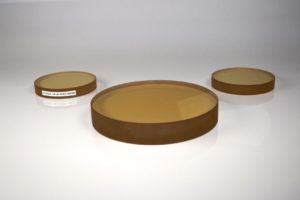 Continuing the discussion on lightweight substrate trends in space optics, Product Manager, Helen Derbyshire, remarks: “When it comes to materials, Zerodur remains a top choice, and the focus on optical payloads is ever-growing. We’ve been collaborating with clients to reduce component payloads by using techniques like honeycombing. This approach removes unnecessary material without compromising the product’s quality or structural integrity.”
High Pressure
Weight reduction is far from the only concern. Engineers, designers, and manufacturers must also account for the intense settings of space, confirming devices remain safe and functional.
Morgan shares her experience of supporting customers navigating challenging atmospheres: “I recently worked with a design for a CaF2 Window that could withstand precise pressures. This involved calculating the pressure difference and diameter to determine the optimal thickness demanded to endure the stress.”
Precision & Perfection
Components aren’t merely simple Prisms, Filters, Beamsplitters, or Domes; they’re the eyes, transmitters, and receivers of today’s space missions. The stakes are incredibly high. A tiny imperfection in surface figure, a slight deviation in wavefront error, or even a minor misalignment in dimensional accuracy could mean the difference between success and failure.
Each element must align perfectly for the mission to succeed, as UK Sales Manager, Selina Edwards, points out: “Space optics must fulfil extremely tight tolerances for parameters like surface figure, wavefront error, and dimensional accuracy, which are critical for performance. Also, optical surfaces must also be free from defects and coated to adhere to exact spectral and environmental expectations, as these circumstances can degrade finishes through UV radiation and atomic oxygen.”
Coatings
To satisfy these rigorous criteria, Selina continues: “MIL-SPEC-compliant coatings tailored specifically for space – for instance, anti-reflective (AR) or high-durability finishes – must be applied. Environmental tests, such as thermal vacuum cycling, humidity resistance, and abrasion testing, are paramount to validate coating efficiency.”
The Future of Space Optics
These key characteristics and considerations have propelled the enhancement of some of the most advanced space technologies, with one in particular standing out. Optics for Earth Observation (EO) are rapidly gaining traction. “EO is at the forefront of research and innovation,” confirms Selina.
“Growth in climate change solutions, including EO, will be a huge development in the next 10 years,” adds Morgan. “And the optics employed to get this data will have a great effect on humanity.”
When asked about the key developments that will influence the design and innovation of optical components in the next decade, Martin concludes: “The demand for higher resolution in satellite imagery, EO, and space telescopes is growing, driven by applications such as climate monitoring, urban planning, and astronomy.”
Your Go-To Source for High-Spec Optical Components
With over 30 years’ experience and a deep understanding of space applications, we’ve honed our ability to meet the most demanding specifications.
When you choose us as your optical component supplier, you gain direct access to a wealth of knowledge and expertise. Whether you need custom-made solutions or stock optics, we’re poised to provide what you need, when you need it.
Explore our offerings and learn more by visiting our website: www.knightoptical.com. Or, for a personal consultation, don’t hesitate to reach out to a member of our team here: www.knightoptical.com/contact/.