

Spectrometers aren’t exactly a new technology. Yet, those working in the photonics industry may have noticed a growing buzz around their applications. Once reserved for specialists in physics, chemistry, and astronomy, these instruments have now branched out into fields as varied as industrial, luxury goods, and conservation sectors. At Knight Optical, we’ve recently expanded our spectrometer portfolio to meet heightened demand, and to mark the moment, we’re exploring the fascinating world of spectroscopy.
Let’s begin with the basics.
What’s the Difference Between Spectroscopy, Spectrometry, and Spectrometers?
• Spectroscopy is the science behind how matter interacts with light
• Spectrometry is the quantitative measurement of that interaction
• Spectrometers are the tools that carry out measurements and enable users to generate spectral data.
What is a Spectrometer?
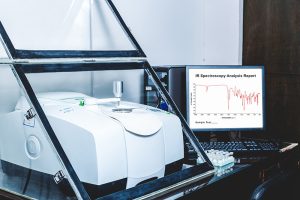
Essentially, a spectrometer is a scientific device that’s used to measure and analyse light. It does this by splitting light into its component wavelengths – a process commonly referred to as creating a ‘spectrum’. This enables users to identify exactly which frequencies are present and to what intensity.
How Does a Spectrometer Work?
A sample is placed under spectroscopic inspection, and the way the light interacts with the specimen reveals integral information about its makeup. While some objects absorb specific wavelengths, others will reflect or emit them. It is the resulting spectral data from this evaluation that is then used to determine the composition and properties of a sample.
The non-invasive, low-cost perks of spectral analysis mean it’s favoured among those looking to reveal more about rare, expensive, and one-off items, and even more markets are switching onto the benefits.
The First Spectrometer
Many tools – including AI overviews (AIO) and search snippets – credit William Hyde Wollaston as the first to build a spectrometer. However, this isn’t strictly true. While Wollaston laid the groundwork, by observing dark lines in sunlight in 1802, it was Joseph von Fraunhofer who, in 1814, created the first instrument that functioned like a spectrometer and could measure spectral lines – by using prisms of different glass. It wasn’t until the 1850s, when Gustav Kirchhoff and Robert Bunsen – who is best known for the Bunsen burner – came together that spectroscopy was firmly established as a scientific method for chemical analysis. This MIT resource breaks the spectrometer timeline down in more detail.
What Are Spectrometers Used For?
Due to their ability to help users understand the atomic and molecular structure of materials, spectroscopy plays a key role in today’s landscape. As such, spectrometers are regularly utilised for things like:
• Verifying the authenticity of diamonds
• Monitoring air and water quality as part of environmental efforts
• Ensuring consistency in manufacturing scenarios through quality control (QC)
• Supporting the preservation of cultural artwork and historical artefacts in conservation
• Detecting fake designer goods in high-end fashion scenes
• Aiding in early disease detection and health monitoring in clinical diagnostics.
Spectrometry isn’t just minimally destructive; it’s also a highly sensitive and fast approach to analysis. This is why it’s being harnessed by so many industries. And, as its reliability becomes more widely recognised, the potential for this technique continues to grow.
The Different Types of Spectrometers
 While they’re typically categorised by the spectrum they analyse – ultraviolet (UV), visible, and infrared (IR) – spectrometers are also defined by application-specific options. These examples include everything from FT-IR (Fourier Transform Infrared) to Raman spectroscopy, and each is suited to various forms of material analysis.
With so many applications possible, there are a range of spectrometers, each designed to meet a project’s specific requirements.
At Knight Optical, we stock a wide range of spectrometers, each engineered for application-specific needs.
These include:
• High-Resolution Spectrometers: For diverse sectors, such as analysing plasma emissions, pharmaceutical compounds, DNA, and protein absorption, and broadband source emission analysis
• High-Sensitivity Spectrometers: For applications that demand compact elements, allowing for low detection limits and minimal stray light
• Near-Infrared (NIR) Spectrometers: For tasks like examining biological specimens and tissues, measuring chemical concentrations or verifying luxury item authenticity
• Raman Spectrometers: For high-precision functions like investigating inorganic materials at 532 nm, observing chemical reactions and detecting illicit substances and pesticides at 532 and 785 nm – and trace-level analytes at 638 nm
• Versatile Spectrometers: For high light-level absorbance measurements, laser LED characterisation, colour and reflectance analysis, UV absorbance of proteins, fluorescence studies in chemical samples, and high-sensitivity analysis
• Microspectrometers: For applications where space availability is minimal, such as OEM gadgets and inline control systems.
Which Optics Are Used in Spectrometers?
High-precision optical components are integrated deep within these devices that make spectral analysis possible. These optics form the ‘eyes’ of the spectrometer, shaping how the device captures and analyses different types of light, whether visible, IR or UV.
You’ll typically find components such as:
• Diffraction Gratings or Prisms: Split incoming light into its component wavelengths
• Mirrors and Lenses: Used to steer and focus the light as it moves through the spectrometer toward the detector
• Aperture Slits: Positioned at the entrance of the system to control precisely how much light enters, which is key to achieving optimal resolution.
At Knight Optical, we don’t just supply spectrometers; we also offer a wide selection of optical components designed to go inside them.
To learn more about our work with spectroscopy, or to explore our optics and accessory range for spectroscopic applications, get in touch with a member of the team today.