

The Evolving Role of Optics in Machine Vision & Automation
Automation has reshaped industries from manufacturing and logistics to agriculture and quality control, by cutting cycle times, raising inspection throughput, and increasing overall accuracy. While machine vision delivers precision, it’s the machine vision optics inside that make a system’s perception layer possible.
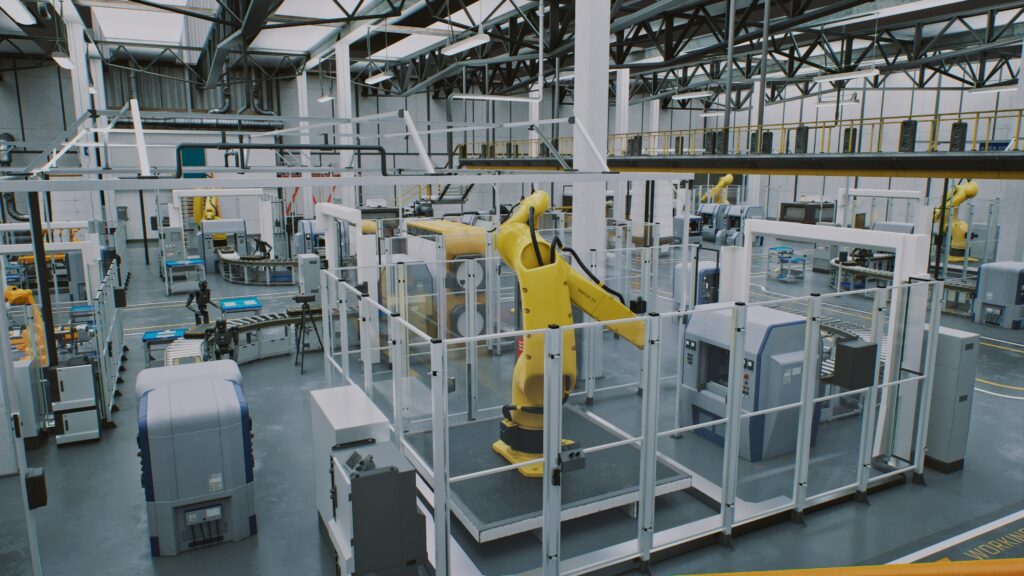
The role of automation is intensifying. Annual robot installations in industrial settings have more than doubled in the last 10 years, according to the International Federation of Robotics (IFR), and this growth is playing out on factory floors worldwide. ‘Lights-out’ facilities operate entirely on automated systems, with vision-guided machinery, such as pick-and-place robots, handling repetitive tasks. Meanwhile, others are employing cobots, often paired with vision systems, and autonomous mobile robots (AMRs) equipped with LiDAR sensors and simultaneous localisation and mapping (SLAM) algorithms.
As adoption grows, machine vision capabilities are set to evolve, too. Consequently, deployments will move into tougher, more varied contexts, meaning optical components will become more sophisticated, increasingly needing to be engineered for higher resolution, tighter tolerances, and smaller form factors in order to keep up with the speed, accuracy, and reliability of automation.
Spectral Control for Targeted Detection
When operating under overhead lighting, machine vision optics must be specified to handle harsh environments. In industrial automation, bandpass filters matched to a system’s LED illumination block ambient light and stabilise exposure across variable settings.
That principle extends beyond single-wavelength filtering, too. In agriculture, pharma, and recycling automation, multispectral and hyperspectral imaging tools isolate many wavelengths at once to identify materials by their spectral signature; for example, post-harvest sorting, pill inspection, and polymer separation.
Whether isolating one wavelength or hundreds, the spectral control provided by filters yields a stronger signal-to-noise ratio (SNR), giving downstream algorithms cleaner images to work with.
Multi-Sensor Optical Paths
Modern machine vision systems commonly require more than one sensor; for instance, platforms that integrate visible (VIS) and near-infrared (NIR) imaging or prism assemblies in 3-CCD cameras. In these cases, beamsplitters, dichroic mirrors, and prisms split and combine optical paths, allowing multiple sensors to capture the same scene simultaneously while keeping device footprints small.
Improving Edge Detection, Inspection, & Flare Control
Especially important in automated inspection lines and sorting systems, machine vision lenses resolve the fine detail needed for accurate edge detection, defect identification, and surface inspection. To suppress ghosting and reduce flare from bright and reflective surfaces, these lenses, alongside other optics in the system, are often given anti-reflective (AR) coatings to ensure a cleaner input for image processing.
How Optics Hold Up in Industrial Conditions
In addition to lighting challenges, systems encounter physical issues. Equipment running 24/7 is subject to thermal cycling, ultraviolet (UV) exposure, and abrasion from cleaning cycles, demanding optical components that can withstand the strain. Here, the choice of coating helps preserve optical performance, with hard-wearing options including diamond-like carbon (DLC) and dielectric coatings providing abrasion resistance and thermal stability, respectively.
However, it’s not just coatings that enable optics to cope with these conditions. Protective windows, typically made from sapphire, shield internal components from dust and impact, while housings handle the shock and vibration associated with industrial operations, offering a genuinely durable optical setup.
As the perception layer of machine vision systems, and as automation processes continue to advance, optics continue to be selected for broader spectral coverage, multi-sensor designs, and custom form factors.
If you’re looking to integrate a new automation set up or iterate or improve an existing one, we’d be delighted to help. To discuss the perfect, get in touch with a member of our team today via the contact page.