
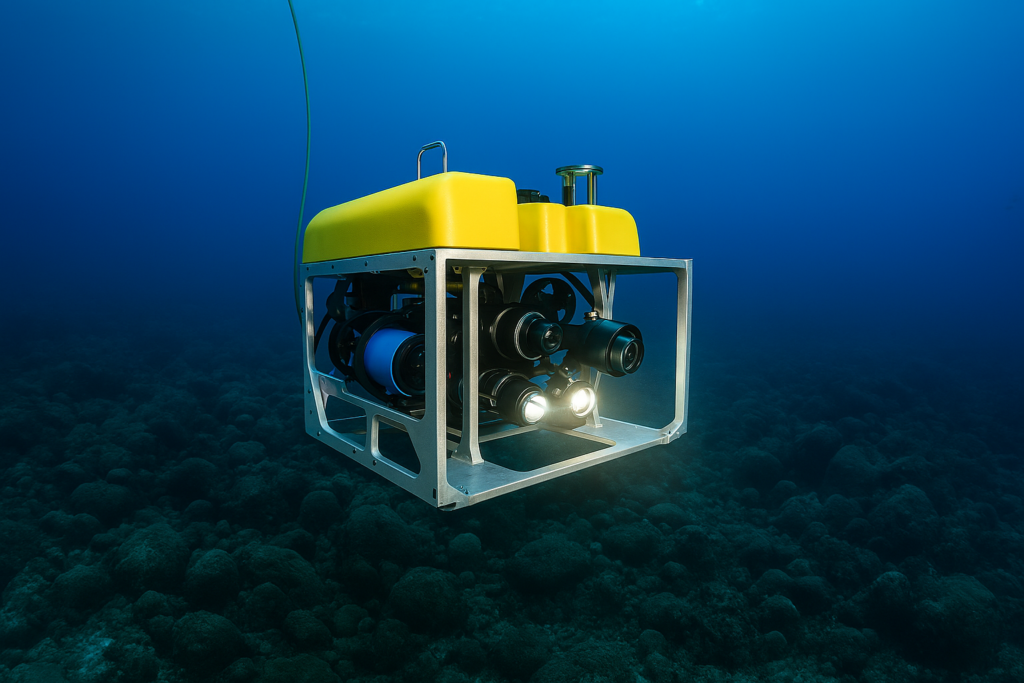
Today’s autonomous underwater vehicles (AUVs) are diving deeper and doing more than ever before. Laser modules are now integral to tasks such as mapping, ranging, alignment, and underwater inspection. But water is a deeply hostile optical environment, with beam divergence, turbidity, and pressure all degrading optical performance in ways far more extreme than anything encountered above the surface. Laser beam expanders are central to overcoming these obstacles, delivering collimated beams that maintain operational performance in even the most unforgiving conditions.
Laser-based technology allows AUVs to sense, measure, and navigate at a level of precision that many other technologies struggle to match underwater. For example, in inspection contexts, they conduct pipeline and infrastructure checks – detecting corrosion, damage, and free spans that could compromise structural integrity. In mapping scenarios, laser scanning and LiDAR systems generate 3D point clouds to build detailed models of seabed terrain impossible to capture from the surface. You’ll also find them supporting docking alignment and remotely operated vehicle (ROV) guidance, while laser range-finding and remote sensing aid obstacle avoidance and navigation in areas where GPS simply can’t reach.
Why Water Works Against Laser Performance
In deep-water laser assemblies, refraction at the water interface changes beam geometry, meaning the laser beam doesn’t travel in quite the original direction or shape it was emitted. For AUV applications, this directly affects pointing accuracy, targeting, and measurement precision, introducing wavefront distortion that undermines the reliability of the platform’s readings.
Turbidity from sediment, marine particles, and algae adds another challenge. The more turbid the water, the more a beam is scattered in multiple directions, rather than travelling cleanly to its target. In practice, this scattering reduces the distance a beam can travel and the sharpness and accuracy of the returned readings.
Wavelength then compounds things further. Water absorbs different colours of light at varying rates: red bands are absorbed rapidly, whereas green and blue wavelengths penetrate farthest. This is why wavelength selection is vital for deep-water laser systems. If the wrong one is selected, power loss at depth proves significant, compromising both range and data quality.
Collectively, these factors add up: when an already-diverging beam hits turbid water, it becomes further dispersed, loses energy due to absorption, and arrives at its destination weakened and distorted, placing the entire optical system under strain.
How Beam Expanders Help
Laser beam expanders give systems the best possible chance of surviving these significant issues by delivering collimated beams, producing both beam expansion and precise optical control.
They do this in two ways:
- Reducing divergence: by keeping a laser beam tighter for longer, beam expanders give AUVs extra range before underwater conditions degrade it
- Controlling illumination profiles: by managing illumination profiles, they also ensure laser light hits targets evenly and consistently, resulting in cleaner, more reliable return signals.
As we explored in our recent blog on beam expanders for laser-cutting systems, optical quality upstream defines system capability downstream, and the same principles apply in subsea applications.
Specified for Survival
Harsh underwater environments not only hinder optical output, they also pose challenges to the physical durability of optical elements too. In these high-pressure situations, optics and their housings must be able to withstand depth-rated pressure cycles, temperature shifts between the surface and target depths, and deterioration from saltwater and biofouling, making sealing, optical coatings, and substrate choice mission-critical.
The most suitable material choices are:
Sapphire
Known for its extreme hardness, sapphire is scratch-, abrasion- and pressure-resistant, making it a frequent choice for viewports and windows on AUVs.
N-BK7 (or equivalent)
With good transmission, N-BK7 (or equivalent) substrates are commonly selected in cases where the cost of sapphire components isn’t justified.
Acrylic
Typically used as optical domes, acrylic is employed in housings that require wide-angle coverage. Although it’s relatively light, it is also worth noting that acrylic is less durable than other materials.
To learn more about Knight Optical’s high-quality, pressure-resistant, and metrology-tested optical components and beam expanders for subsea operations, contact a member of the team today.
Alternatively, you can find out more about beam expanders by checking out our video below. If you’d like more content on our optics and how they power a range of incredible, real-world projects and applications, make sure you subscribe to our channel.