

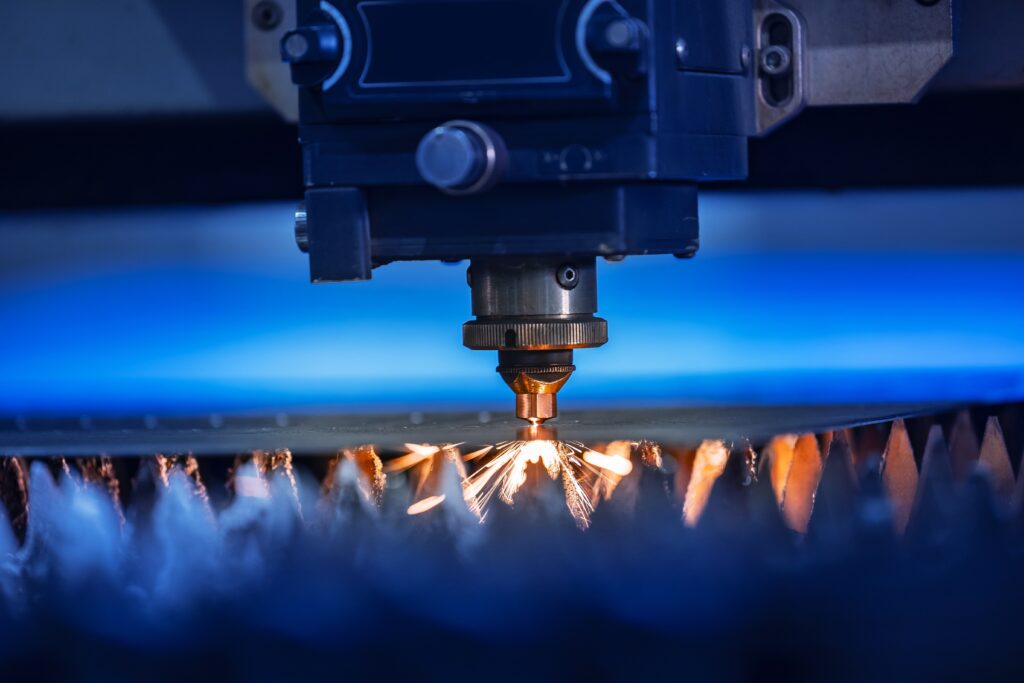
Laser cutting is a game of precision, and it’s one that’s constantly placing greater demands on every component in the optical chain. Compared to early models, which ran at 500-2000W, today’s most advanced machines run at 6kW to 20kW or above. For optical design and specification, this translates to higher power-handling requirements and less room for optical imperfection. As a result, the optical quality of beam expanders has never been so critical to the laser beam quality on which laser-cutting systems rely on.
How Beam Expanders Shape Laser-Cutting Performance
Beam quality in laser-cutting equipment isn’t merely a specification; it directly dictates what a system can do, how effectively it does it and, ultimately, the standard of the final cut. Laser beam expanders are integrated within machines to deliver collimated beams, thereby enabling beam stability and minimal divergence. Without appropriate expansion, beam divergence goes unchecked, the focused spot loses definition, and cut accuracy suffers. But it’s not simply their presence that’s key to optimal operation – they need to be well-specified, too.
The right laser beam expander specification has a direct influence on:
- Cut accuracy: with a tighter, highly stable beam, laser-cutting equipment can produce finer, better-controlled cuts
- Kerf width: beam diameter at focus determines how narrow – or wasteful – the cut can be
- Thermal effects: inadequate laser beam quality generates excess heat, causing substrate distortion and heat-affected zone (HAZ) complications
- Process repeatability: in production-intensive operations, consistency across hundreds, or even thousands, of cuts is the difference between success and unacceptable reject rates.
What Happens When Optical Quality Falls Short?
Poor-quality optics, whether due to substandard manufacturing or incorrect specification, lead to real-world, measurable consequences in laser-cutting. Surface imperfections on lenses cause scattering and can introduce spherical aberrations, redirecting energy away from the beam path and reducing power at the focal point.
Unsuitable or absent anti-reflection coatings on lenses compound the issue by absorbing or reflecting light intended for the workpiece, often prompting operators to compensate with higher-power settings. Here, components must meet a defined optical damage threshold – failure to do so will simply accelerate optical degradation and increase the risk of catastrophic optical failure. Meanwhile, sub-standard surface polishing and material inconsistencies create wavefront errors that result in focal point shift and thermal lensing, compromising cut definition and edge quality.
Collectively, these issues aren’t confined to the optical assembly; they translate directly into scrap material, expensive rework and slower cycle times, inevitably undermining the throughput and efficiency essential to laser material processing.
Optical Configurations & Where Tolerances Matter
Beam expansion factors vary between setups and must be matched to application-specific parameters. Beam expanders are split into two types – Keplerian and Galilean – and that distinction matters for integration into laser-cutting systems. The Galilean design, which uses a positive and a negative lens with no internal focal point, is generally the preferred solution for heavy-duty industrial applications. This is because they’re more compact than their Keplerian counterparts, manage high powers reliably, and carry no risk of focus at an intermediate point.
Keplerian setups – which use a positive and a negative lens – offer superior beam quality through spatial filtering, which is useful where beam cleanliness is the priority over size.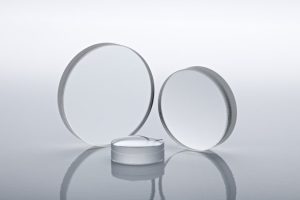 Achromatic lenses are commonly used in Keplerian designs where control of chromatic aberration is needed alongside beam quality.
Within both Keplerian and Galilean assemblies, component tolerances, such as focal lengths, centration, surface figure, polish quality and coating uniformity, fundamentally determine whether the expander performs as intended and whether wavefront errors remain within acceptable limits.
Substrate choice is equally significant. Fused silica lenses are often employed for high-power and UV applications, offering a high optical damage threshold and stability that spans a broad spectral range.
The Environmental Realities of Industrial Laser Cutting
External operating environments are as important a consideration as optical configurations, wavelength ranges, and power thresholds. Substrates, coatings, and the overall setup must withstand the conditions these machines are regularly subjected to.
For example, the heat cycles typical of industrial laser cutters trigger expansion and contraction (coefficient of thermal expansion, or CTE), which affect alignment; mechanical vibration from CNC motion can shift optical elements; and airborne particulates from the laser-cutting process degrade exposed optical surfaces over time. Specifying beam expanders that handle these challenges is what separates consistent performance from costly downtime.
Watch: The Optics Behind Laser Cutting
To learn more about the optical components utilised in laser cutting, watch our video below. Be sure to visit our YouTube channel and subscribe for more videos on optical components and how they’re utilised by some of the world’s morst critical industries.
To find out more about our laser beam expanders or to discuss custom optical requirements, get in touch with a member of the Knight Optical team today.