
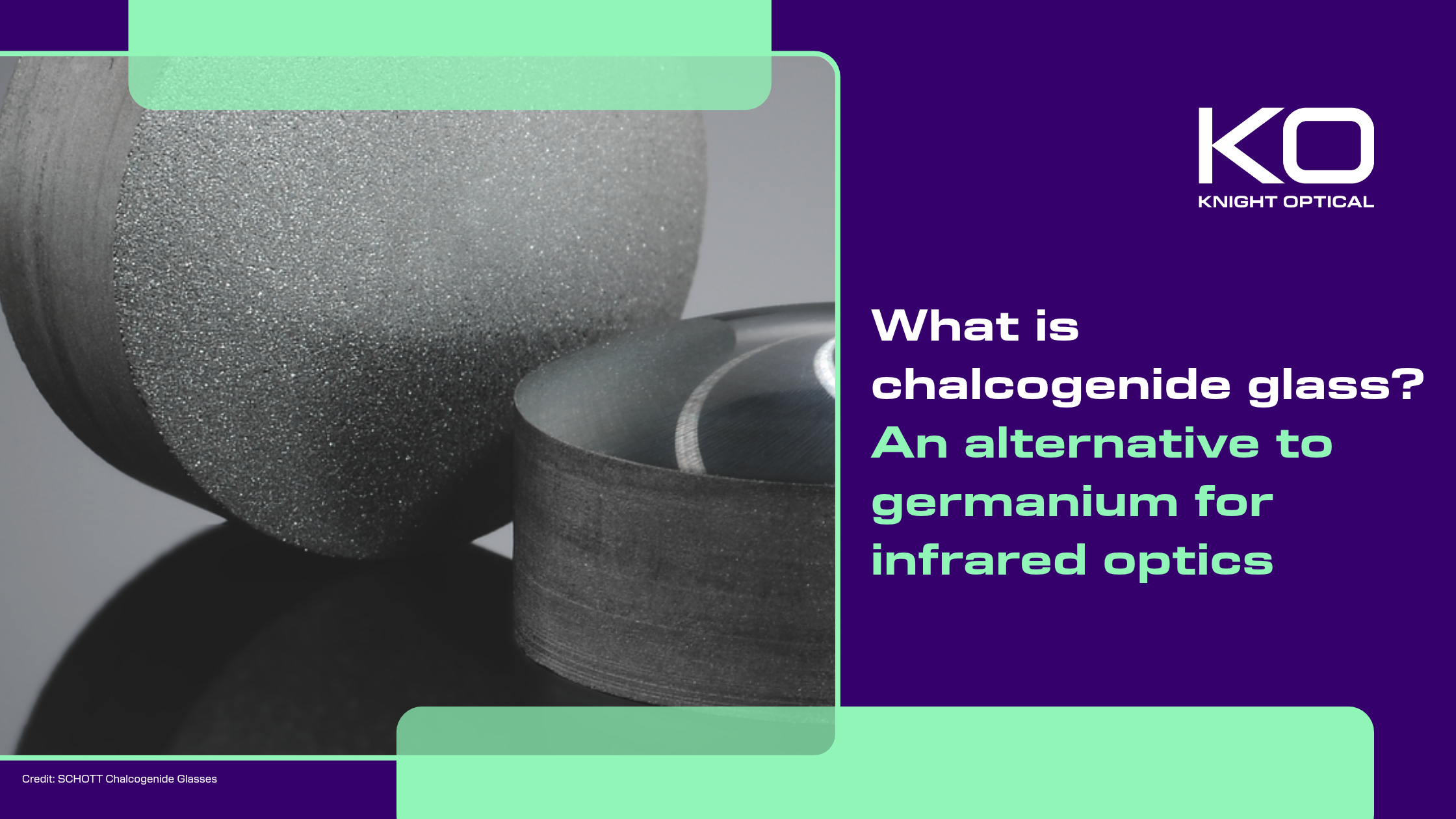
What is chalcogenide glass? An alternative to germanium for infrared optics


Germanium has become very difficult to source, which is problematic for optical engineers who are building thermal imaging or other infrared systems.
Chalcogenide glass transmits across the same mid-wave and long-wave infrared (MWIR and LWIR) bands, can be moulded into complex lens shapes, and holds focus better as the temperature changes.
Buy Products Online Order Custom Optics
What is chalcogenide glass?
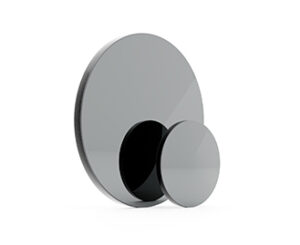 Chalcogenide glass is an infrared-transmitting glass that contains one or more of the chalcogen elements sulphur, selenium and tellurium. These are melted with elements such as germanium, arsenic or antimony to make an amorphous glass. Because it has no crystal structure, its optical properties are uniform in all directions, and it transmits well into the infrared, where silica-based glasses are opaque.
There are three main types:
- Selenide glass is the most widely used type in thermal imaging and typically transmits from about 1 µm to 14 µm, covering both the MWIR and LWIR bands.
- Sulphide glass transmits from closer to the visible out to about 10 µm and is often drawn into infrared fibres.
- Telluride glass transmits beyond 20 µm and is mostly used in research and sensing.
Adjusting the composition changes the refractive index, thermal behaviour and transmission range. Chalcogenide glass is available from a variety of manufacturers, each offering slightly different optical and mechanical properties. Commercial ranges include AMTIR, GASIR and SCHOTT IRG.
A replacement for germanium in IR optics
Germanium supply is unpredictable, with long lead times across the optics industry, and prices have risen sharply. Even when it is available, every germanium lens must be ground, polished or diamond turned individually, which adds cost.
There are technical drawbacks too. Germanium is dense (about 5.3 g/cm³), which adds weight to handheld and airborne systems, including drones. Its refractive index changes strongly with temperature, so the focus drifts as the system warms or cools. Above about 100 °C it also suffers from thermal runaway: absorption rises with temperature, the material heats further, and transmission drops sharply.
SCHOTT IRG chalcogenide glass vs germanium
Values are approximate and vary by grade, wavelength and temperature.
| Grade | Composition | Transmission (µm) | n @ 10 µm | dn/dT @ 10 µm (10⁻⁶/K) | Tg (°C) | CTE (10⁻⁶/K) | Density (g/cm³) |
| IRG 22 | Ge33As12Se55 | ≈0.7–14 | 2.4968 | 67.1 | 368 | 12.5 | 4.41 |
| IRG 25 | Ge28Sb12Se60 | 1–14 | 2.6030 | 61.1 | 285 | 14.0 | 4.66 |
| IRG 24 | Ge10As40Se50 | 1–14 | 2.6090 | 20.3 | 225 | 20.0 | 4.47 |
| IRG 26 | As40Se60 | 1–14 | 2.7781 | 32.1 | 185 | 21.4 | 4.63 |
| IRG 27 | As₂S₃ | 1–10 | 2.3873 | −3.7 | 197 | 22.5 | 3.20 |
| Germanium (ref.) | Ge (crystal) | ≈2–14 | 4.0032 | 396 | n/a | 6.1 | 5.32 |
The advantages of chalcogenide glass
The biggest technical advantage is focus stability. The refractive index of chalcogenide glass changes much less with temperature than germanium. For IRG 22 the change is about a sixth. Lenses therefore stay in focus over a wider temperature range, and many designs can be athermalised passively, without motorised refocusing.
Chalcogenide glass can also be precision moulded. Aspheric and diffractive surfaces can be produced in volume at a lower cost per part than diamond turning, which suits production thermal imaging lenses.
Chalcogenide glass is lighter than germanium, and its lower refractive index means less light is reflected at each uncoated surface. Lenses can be colour corrected by combining different chalcogenide grades. Some grades contain only a small amount of germanium, and others, such as arsenic selenide, contain none.
Designing with chalcogenide glass
Moving a design from germanium to chalcogenide glass is usually straightforward, but there are a few things to allow for. The lower refractive index means surfaces need more curvature, although aspheres help keep the element count down. Chalcogenide glass is also softer than germanium, so we recommend a hard coating on any exposed surface.
Temperature affects chalcogenide glass in two separate ways. Its refractive index changes far less with temperature than germanium’s, with a dn/dT of a sixth or less, so focus stays stable and athermal designs are simpler. The glass itself, however, expands more with heat (its thermal expansion coefficient is roughly two to four times that of germanium), so lens mounts and housings must be designed to accommodate the extra movement.
Many grades, including AMTIR-1, contain arsenic. It is safe in a finished optic, but grinding and polishing must follow proper handling procedures, which an experienced supplier will manage.
Applications and coatings
Chalcogenide optics are used in thermal imaging cameras, automotive night vision, security and surveillance, firefighting, defence and aerospace, UAV payloads, gas sensing, infrared spectroscopy and infrared resolution targets.
Most chalcogenide optics are coated. Broadband anti-reflective (BBAR) coatings reduce reflection losses, hard coatings such as diamond-like carbon (DLC) protect the exposed outer surfaces, and hydrophobic coatings are used on outdoor optics.
Chalcogenide optics from Knight Optical
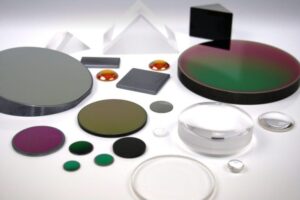 We offer ready-to-ship uncoated 25.4 mm diameter SCHOTT IRG chalcogenide windows. We can also provide custom chalcogenide glass optics, such as windows and lenses, typically 5 mm to 100 mm in diameter, and with coatings including BBAR and DLC, covering popular thermal wavebands. We supply everything from one-off prototypes to large production runs.
Every component is evaluated in our metrology laboratory and passes 100% QA inspection.
If you are also weighing up zinc selenide, read our article Zinc Selenide: The Germanium Alternative.
If you are replacing germanium in an existing design or starting a new infrared system, our technical sales team can help you specify the right chalcogenide optics. Explore our chalcogenide range or contact our team to discuss your requirements.