
To mark our attendance at the upcoming Aerospace & Defense Meetings Torino in Italy (2nd-4th December), we reveal how gatherings like these aren’t just for showcasing products; they’re where the true innovation happens. Here, face-to-face discussions with engineers, optical designers and procurement specialists not only help bridge supply chain gaps but additionally assist in speeding up R&D and prototyping phases, and spark collaborative problem-solving that drives the industry forward as a whole.

In the defence sector, staying ahead of the curve matters, and learning from global peers is how companies can uphold their edge. For instance, different countries frequently encounter diverse obstacles – such as Arctic climates versus desert settings – and cross-border exhibitions can provide a platform where like-minded individuals can come together to share technical knowledge – especially from an optical design perspective.
Optical Components for Defence
Optical instruments are at the centre of many applications, enabling everything from thermal imaging in night vision systems to intelligence, surveillance, target acquisition and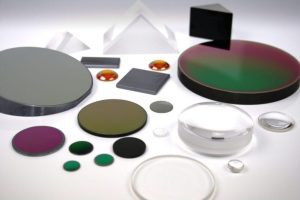 reconnaissance (ISTAR) and artillery sighting equipment.
The defence optics that are displayed and the bespoke solutions that are discussed at industry gatherings end up in real-life optical designs that safeguard people, borders, and assets. For example, at Knight Optical, infrared optics showcased at previous trade shows now serve as core elements in next-gen night vision goggles, initial enquiries concerning laser optics have evolved into mass production for laser rangefinding systems and discussions around optical coatings – such as diamond-like carbon (DLC) and hydrophobic coatings – have led to robust solutions that protect sensors in extreme battlefield environments.
What’s Happening in Defence Optics in 2025?
As the sector’s demands quickly evolve, 2025 has, so far, proven to be a pivotal year for electro-optical hardware, such as:
Miniaturisation of Drones
Optical instruments are getting smaller across many industries – frequently calling for custom-made optical components with bespoke dimensions and tolerances. However, in the defence domain, the requirement for reduced-weight, compact components is even greater and is highly dependent on keeping drones airborne for longer, therefore, ensuring mission success.
Augmented Reality (AR)
Augmented reality (AR) continues to prove its worth in the military, particularly for situational awareness. With increasing investment in AR-enabled head-mounted displays (HMDs) for soldiers, advanced optics and sensors work in tandem within these systems to overlay tactical data onto real-world views.
AI & Algorithms
Counter-drone tech is growing rapidly. For example, optronics are being integrated with AI and algorithms for automatic threat detection with multispectral cameras – using ultraviolet, visible and infrared optics – helping to identify small, fast-moving targets.
LiDAR Systems
Although utilised for decades in the field, LiDAR (light detection and ranging) has been further developed in recent years for sophisticated tactical mapping, object identification and infrastructure management. Also used for autonomous driving – much like you’d find in some cars – these platforms rely on a series of LiDAR optical components. Typically produced in custom configurations, they’re specifically chosen to withstand demanding operational circumstances.
Popular Optical Components Behind Defence Systems
As requirements intensify and innovations continue to advance, so do the expectations of optical components. For instance, LiDAR devices for unmanned ground vehicles need rugged optics that can maintain precision despite vibration and harsh terrain. Night vision devices are shifting to compact, lighter image enhancement technologies that don’t compromise on clarity. Meanwhile, guidance systems call for optics with ever-tighter margins to meet evolving accuracy benchmarks. Elsewhere, biometric fingerprint recognition – for base access control – depends on scratch-resistant substrates and specialised coatings.
While each component has its own purpose, the main thread that connects defence optics is their flawless performance under unforgiving conditions.
Knight Optical’s Role in Supporting Defence Innovations
Next week at Aerospace & Defense Meetings Torino, we look forward to those crucial in-person conversations that simply can’t happen via email. Whether it’s discussing substrate options for a new thermal imaging project, troubleshooting tolerance criteria for guidance systems or exploring custom optical coating solutions, these opportunities present the moments where tangible progress is often achieved. 
With over 30 years’ experience and an in-house metrology laboratory that tests components to precise specifications and a dedicated QA department that meticulously checks all optics – including MIL-SPEC standards – we understand the unique needs of the sector. We also value the importance of the collaborative relationships that stem from events like this, where complex challenges can be overcome collectively and supply chains can become partnerships.
To make an appointment with a member of the Knight Optical team at Aerospace & Defense Meetings Torino, contact us here. For more information on our custom and stock optical components for defence, visit the tabs on our website.