

Why optical component selection matters in automated inspection


Machine vision systems have become an integral part of modern manufacturing. From product inspection and measurement to sorting and traceability, they enable equipment to make decisions at production-line speeds.
As adoption grows, so does reliance on the quality of the image data being captured. Even the most advanced software can only work with the information it receives. Optical filters, windows and coatings therefore play a significant role in determining inspection accuracy, repeatability and overall system performance.
Controlling unwanted light in machine vision systems
Automated Optical Inspection (AOI) systems rarely operate under ideal lighting conditions. Ambient daylight changes throughout the day, factory lighting can introduce glare and uneven illumination, and many manufactured parts contain reflective surfaces.
These factors introduce unwanted light alongside the information the system is trying to capture. The result can be inconsistent image contrast, colour variation and reduced repeatability, making reliable inspection more difficult.
Inconsistent illumination can cause intensity variations, poor repeatability and colour mismatches, while reflective surfaces generate stray light that obscures fine detail. In food sorting and pharmaceutical inspection, this leads to missed defects and undetected contamination, as well as the inverse problem of false rejects, where good product is discarded unnecessarily, creating waste and hurting yield.
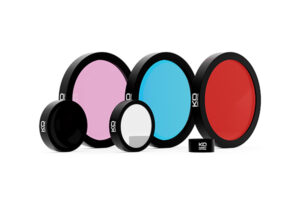
Interference bandpass filters help reduce these challenges by transmitting a specified wavelength range while blocking unwanted light. When matched to an LED illumination source, they improve image contrast and minimise the influence of ambient lighting. This can make defects, dimensional variations and colour differences easier to distinguish during inspection.
Filter specification affects system performance: broadband filters are often selected where maximising light throughput is the primary requirement; narrowband filters typically perform better where ambient light rejection is critical; standard filters match common LED illumination wavelengths; and UV filters can reveal fluorescence or coating features that are invisible in the visible spectrum.
When filter performance affects inspection accuracy
A mis-specified bandpass filter can reduce inspection accuracy, increase false rejects and make it harder to distinguish defective products from acceptable ones.
In automotive manufacturing, a missed weld defect can mean a recall; in pharmaceuticals, an undetected contaminated blister pack carries regulatory and patient safety consequences; in food and drink production, an undetected foreign body can trigger a product withdrawal. The quality of the optical path has a direct influence on inspection accuracy and repeatability.
Engineers specifying these systems understand this, but the point can be lost when component selection is treated as procurement rather than a technical decision. A filter that performs well in one environment may not deliver the same results elsewhere. Small differences in ambient lighting, surface reflectivity or illumination wavelength can affect image quality and inspection consistency over time.
Maintaining performance over the life of the system
AOI systems often operate continuously and may be exposed to thermal cycling, vibration, UV radiation and aggressive cleaning processes. Changes in optical performance can affect measurement consistency and defect detection accuracy, particularly in systems operating continuously for long periods.
Diamond-like carbon (DLC) coatings provide abrasion resistance for components subject to regular contact or cleaning; dielectric coatings offer thermal stability under temperature cycling; and protective windows, typically sapphire for its hardness and optical transmission, shield internal components from dust and impact, maintaining the optical path as installed.
Optics for high-speed material identification
Beyond pass/fail inspection, material identification at high throughput introduces more complex optical demands.
In recycling automation, hyperspectral imaging (HSI) systems scan conveyor lines at speeds up to 3 m/s, identifying polymers (PET, HDPE, PVC, polypropylene, polystyrene, and ABS) by their distinct spectral fingerprints in the near-infrared (NIR) and short-wave infrared (SWIR) regions, provided the optical system can capture accurate spectral information under real production conditions.
Research published by UCL in 2025 reported plastic packaging classification accuracies of up to 97% using hyperspectral imaging. Results such as these show the importance of capturing accurate spectral data before classification takes place.
At these conveyor speeds, optical components require high transmission to ensure sufficient light reaches the sensor during short integration times. Shiny mixed-material surfaces create stray reflections and flare; bandpass filters isolating target NIR and SWIR wavebands block this interference and keep readings clean. Although the application is different, the objective remains the same: maximise useful signal and minimise unwanted light reaching the sensor.
Why optical specification matters
A machine vision system is only as reliable as the data reaching its sensor. Careful selection of filters, coatings and protective optics can improve image quality, reduce false rejects and help maintain consistent inspection performance over the lifetime of the equipment.
Knight Optical supplies precision optical components for machine vision and automated inspection applications across manufacturing, food processing, pharmaceutical production and recycling industries.
Our team works with engineers to specify optical filters, windows and custom components that meet the performance requirements of their application.