
Domes and windows are among today’s most essential and widely used optical components. From smartphones, barcode scanners and surveillance systems encountered in everyday life through to high-spec satellite imaging technologies, ROVs and underwater photography, these optics are ubiquitous. But choosing the right one depends on the setup, working environment and wavelength range. Here, we explain when you should select an optical dome over a window and explore key substrates and optical coatings.
Both flat and dome windows protect optical systems while transmitting light, but they’re not interchangeable. The type you opt for has a direct impact on the optical performance of a system, its resilience and field of view (FOV).
When Should You Use an Optical Dome?
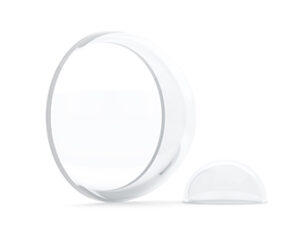 Due to their shape, these hemispherical windows are naturally stronger under pressure, which is why they’re popular in uses such as marine research and infrastructure surveying, where they’re deployed as subsea domes in submersible vehicles and underwater imaging cameras.
Their form also allows for a greater FOV (although their curvature can create magnification effects) while ensuring the optical path isn’t disrupted. Therefore, you’ll commonly spot them being used beyond the subsea sector – protecting camera lenses and optical sensors while providing wide-angle viewing in CCTV operations, supporting aerial navigation systems and even shielding equipment in film and television production.
If your project operates in extreme-pressure scenarios, challenging conditions – such as deep-sea exploration or military applications – or simply requires a wider FOV, optical domes are likely the ideal fit.
When Should You Use an Optical Window?
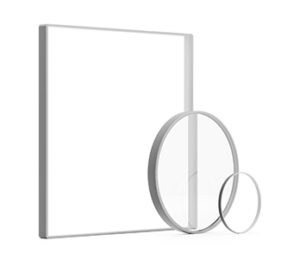
For setups that call for flat optical surfaces to serve as protective barriers while transmitting light, optical windows are a versatile, simple-to-integrate component. Unlike domes, they won’t introduce magnification, which is particularly important for narrow FOV uses. As a result, flat windows are typically favoured in applications such as laser systems, machine vision, thermal imaging – such as building inspection and industrial monitoring – and safety viewports.
In short, where magnification isn’t needed and easy integration is a priority, optical windows are usually better suited.
Optical Materials & Coatings
The material and optical coating you select will depend on several factors: if your system works with UV, visible or IR light; the level of environmental resistance demanded; operating temperature; mechanical durability and, of course, budget.
Optical Materials
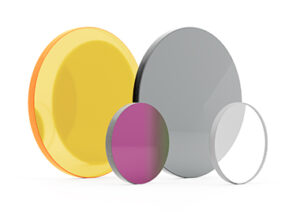
Getting the substrate right is key to optical performance. For example, visible-range setups benefit from BK7 glass as both a cost-effective and durable option. Where UV light transmission is required, materials such as UV-grade fused silica perform down to 185 nm, and for harsh environments that require superior toughness, sapphire is a common choice. Lastly, for the IR spectrum – for instance, thermography and gas detection – zinc selenide and zinc sulphide offer excellent transmission at longer wavelengths.
Optical Coatings
To further enhance efficiency, optical domes and windows can be treated with anti-reflective (AR) coatings, as well as hydrophobic, oleophobic and diamond-like carbon (DLC) coatings to improve longevity and surface quality.
To find out which optic, coating and substrate best suits your application – whether from stock or custom-made – get in touch with a member of our team today using the button below.
Oceanology International 2026
If you’d to see the quality of Knight Optical components for yourself, you’ll find us at this year’s Oceanology International, running between 10-12 March at London’s ExCel centre. Visit us at stand Q18 to check out our sector leading optical components, speak with members of our expert team, as well as be in with a chance to win a LEGO set of The Endurance!