

Understanding How Optical Prisms Work & When to Use Each Type
Prisms are fascinating optics that manipulate light in two ways: refraction and total internal reflection. While some disperse light into wavelengths, others rotate images and direct or control the positioning of beams. The key is to identify the process and model that best suits your demands. In this overview, we explain how prisms perform, focusing on two frequently employed types, dispersive and reflecting.
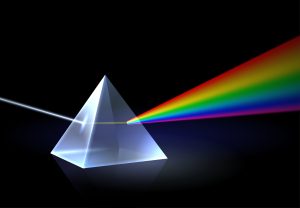
How Prisms Operate
Manufactured using materials like N-BK7, UV-fused silica and specialised substrates like Zinc Selenide (ZnSe) and Germanium (Ge), prisms are transparent components with flat, polished surfaces that alter light with their geometric form.
They achieve this in two ways:
1. Refraction:
When light passes through a prism, it bends. This is due to the change in optical density between air and the material. The bending result essentially allows the prism to steer light beams and depends on two variables: the prism’s shape and its refractive index.
Different wavelengths bend to different extents during refraction, which creates the dispersion effect prisms are known for – i.e. splitting white light into its constituent colours.
2. Total internal reflection:
This happens when light within the prism encounters an inner surface at a steep angle, which is typically greater than the critical angle of the material itself. Instead of passing through the surface, the light reflects entirely off the internal boundary, all without the requirement of mirror coatings.
This phenomenon allows prisms to redirect beams, invert images and control optical paths with minimal light loss.
Considerations for Picking Prisms for Your Projects
These two mechanisms enable very specific prism capabilities. Some designs primarily use refraction to separate spectral bands or steer beams, while others leverage total internal reflection (TIR) to redirect light and modify image orientation.
The primary concern for specifiers is to understand which mechanism best serves their application, allowing them to determine the most appropriate prism. High precision is also a key consideration; even if a 90º angle is off by a few arcseconds, the system won’t behave as intended. That’s why accurate manufacturing and testing are essential when choosing an optical component supplier.
At Knight Optical, our metrology laboratory equipment is capable of 3-arcsecond testing – an incredibly precise measurement, which identifies even the smallest inaccuracies and confirms that every prism you receive performs exactly as expected.
Dispersive or Reflecting Prisms?
Together, these principles of physics and precision engineering allow for four main categories of prisms: dispersion, deviation, rotation and displacement. Similar to substrate choice, each one is specifically optimised for distinct purposes.
The two most widely specified in precision optical systems are dispersive and reflecting prisms.
Dispersive Prisms
True to their name, these components work by dispersing light. This spectral dispersion occurs when various wavelengths of light bend by different amounts as they pass through the prism.
Here at Knight Optical, we supply numerous kinds of dispersion prisms, such as:

Equilateral Prisms:
With their simple, triangular cross-section structure and three equal 60º angles, the equilateral prism is often manufactured in substrates that have a high refractive index, perfect for maximising separation between wavelengths.

Pellin-Broca Prisms:
Pellin-Broca Prisms always direct light at the same 90º angle; you simply rotate them to choose which colour emerges. Our custom UV-fused silica versions take this further, with input and output faces positioned at Brewster’s Angle for 240nm wavelengths.
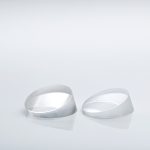
Wedge Prisms:
The small wedge angles on these components use refraction to create controlled beam deviation with minimal dispersion. With near-parallel faces, when used in pairs, they can accurately steer the path of a beam without separating wavelengths.
Reflecting Prisms
While dispersive prisms are responsible for chromatic dispersion, reflecting varieties redirect white light through TIR. This enables management over both beam direction and image orientation.
There are several popular reflecting prisms in our portfolio, including:
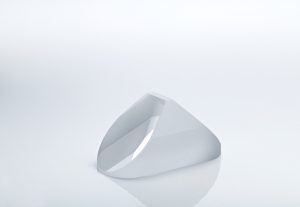
Porro Prisms:
These optical prisms function in pairs to displace and invert light beams using TIR, which makes them beneficial for precise imaging uses.
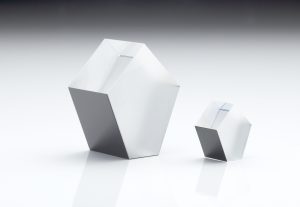
Penta Prisms:
With five sides, Penta Prisms offer a distinctive advantage: constant 90º beam deviation, regardless of incident angle. This eliminates complex demands in optical setups, making them particularly favoured in fields like surveying equipment and range finders.
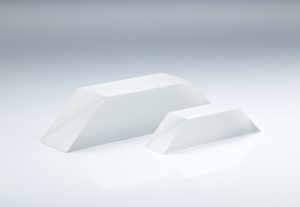
Dove Prisms:
Shaped like a truncated right-angle prism, Dove Prisms are commonly used for image rotation applications. As such, they’re increasingly valuable in the worlds of astronomy and interferometry.
Our catalogue also includes Rhomboid Prisms for lateral beam displacement projects.
Which Optical Prism is Best for Your Application?
Understanding dispersion and TIR is key to determining the most suitable prism for your project. Whether you need speciality components for satellite communication, beam control for high-performance instruments or coated and uncoated variants for certain spectral specifications, our selection of custom and stock optics delivers the quality your projects demand.
When selecting optics for your application, consider wavelength, power handling requirements and operational settings. For standard applications with flexible timelines, our extensive stock range of prisms offers immediate availability. However, projects that require more demanding criteria, unique dimensions or extreme environmental conditions may call for custom optical prism solutions.
Knight Optical’s experienced technical sales team can guide you through these decisions, ensuring maximum results while managing costs and delivery schedules.
For further information, contact us today.