
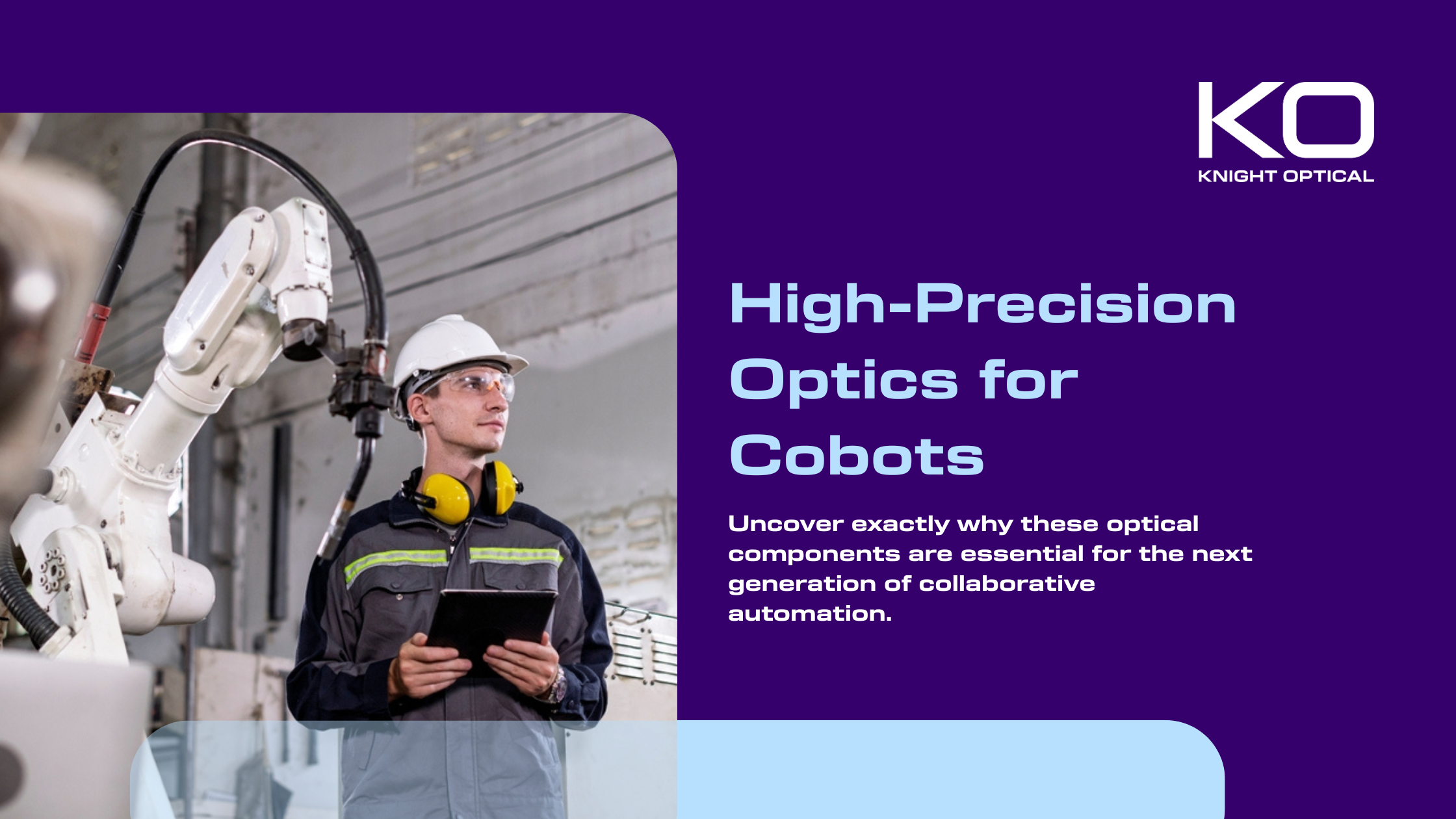
Collaborative robots, or cobots, are transforming a wide-range of industries by safely and efficiently working alongside humans in a number of roles. As their capabilities expand, so does the importance of the components that enable them to “see,” detect, measure, and interact with their environments. Among the most critical of these components are high-precision optics.
In this article, we explain what cobots are, explore their real world applications, and uncover exactly why these optical components are essential for the next generation of collaborative automation.
 What Is a Cobot?
A cobot (collaborative robot) is a type of robot specifically designed to work closely and critically, safely, with humans without the need for external safety cages or barriers. Cobots are able to achieve this through force‑limiting mechanisms, advanced sensors, and responsive control software that detects and adapts to human presence. Unlike traditional industrial robots, which typically operate at high speeds in isolated environments, cobots are engineered specifically to share workspaces and adjust their behaviour in real time.
Traditional robots excel in high-volume, repetitive, and high‑speed operations but require segregation for safety. On the other hand, cobots prioritise safety, flexibility, and ease of deployment, making them accessible tools for both small and medium‑sized manufacturers as well as large facilities. Their built‑in sensors and user-friendly programming interfaces allow operators to reconfigure them quickly, supporting low‑volume, varied, and rapidly changing production tasks.
Applications, Uses, and Industries for Cobots
Cobots use has grown rapidly across industries thanks in part to their adaptability and focus on safety. They perform a huge number of varying roles, ranging from assembly and machine tending to quality inspection, logistics, agriculture, healthcare, and even surgical assistance. Their ability to support tasks that may be repetitive, ergonomically challenging, or ultra‑precise has accelerated their adoption worldwide in recent years.
Industries embracing cobots include:
- Manufacturing & Assembly: handling parts, welding, fastening, and performing consistent and repeatable tasks.
- Electronics: precision assembly and inspection where delicate components require gentle, accurate manipulation.
- Logistics & Warehousing: pick‑and‑place, palletising, and materials transport in dynamic environments.
- Healthcare & Laboratory Automation: assisting staff, supporting sterile processes, or performing repetitive lab tasks.
- Food & Beverage: packaging, sorting, and quality inspection.
The growing robotics market as a whole highlights cobots’ increasing importance: the global cobot market reached $2.3 billion in 2025, rising toward $3.1 billion in 2026, with especially strong adoption among small and medium‑sized enterprises.
What Are High‑Precision Optics?
High‑precision optics are optical components such as lenses, mirrors, windows, filters, prisms, and beam splitters manufactured to extremely tight tolerances to control light with exceptional accuracy. These components enable the advanced imaging, sensing, and measurement systems used throughout robotics, machine vision, and automation.
High‑precision optics allow robots and cobots to:
- Capture high-resolution visual data
- Detect objects, distances, and surface features
- Navigate dynamic environments
- Enable 2D and 3D machine vision systems
- Perform quality inspection and metrology tasks
At Knight Optical, we have a long-standing and successful history supplying custom optics and stock optical components for robotics, machine vision, deep learning, 3D imaging, embedded vision systems, and more. Our metrology‑validated, quality‑assured parts support everything from surgical robotics to autonomous delivery robots.
Photonics technology – lasers, optical sensors, LiDAR, machine vision, and fibre optics – plays a transformative role in robotics. These optical systems allow robots to perform critical tasks such as perceiving their environment, processing visual information, and making informed decisions.
Why High‑Precision Optics Matter for Collaborative Robots (Cobots)
Cobots rely heavily on high-precision optics to achieve safe, accurate, and intelligent interaction. High‑precision optics are essential across several of a cobot’s core functions:
Vision and Imaging for Object Detection
Machine vision systems equipped with optical lenses, filters, and sensors allow cobots to identify shapes, textures, colours, and defects. This enables them to pick parts, perform detailed assemblies, and make decisions in real time.
Navigation and Spatial Awareness
Optical technologies such as LiDAR, 3D cameras, and vision sensors provide cobots with spatial mapping and depth perception, which are crucial for safe human‑robot collaboration and for navigating complex, unstructured environments.
Safety and Human Proximity Detection
It is critical that a cobot is able to detect human presence quickly and reliably. Force‑limiting sensors, laser range finders, and optical proximity sensors allow cobots to adjust their speed or stop instantly when a human enters their workspace.
Precision Alignment and Metrology
High‑precision optics enable the microscopic accuracy required in fields such as electronics assembly, medical device manufacturing, and quality inspection. Optics allow cobots to work at tolerances far beyond unaided mechanical systems.
Enabling AI‑Driven Robotics
As cobots integrate advanced computer vision and AI, photonics and optical systems provide the foundational data for tasks such as object classification, pose estimation, and semantic mapping.
Meeting Industry 5.0 Requirements
Industry 5.0 emphasizes human‑robot collaboration, adaptability, and high‑mix production environments. High‑precision optics allow for the advanced sensing and decision-making capabilities required for cobots to operate safely and efficiently in these hybrid settings.
The Future of High‑Precision Optics in Cobots
The relationship between optics and robotics is expected to deepen dramatically in the years ahead:
AI‑Enhanced Vision Systems
Combined computer vision and AI models are enabling cobots with adaptive, context‑aware perception. Future optical systems will integrate multimodal sensors, higher-resolution imaging, and advanced spectral analysis.
Industry 5.0 Integration
Industry 5.0 focuses on human‑centred collaboration. Optics will enable cobots to better anticipate human motion, maintain safety, and support high-precision in mixed workflows.
Growth in Autonomous Mobile Robots (AMRs)
As AMR use grows, advanced optical systems (3D cameras, LiDAR, depth sensors) will remain central to navigation and obstacle avoidance.
Increasing Miniaturisation and High‑Performance Optics
Demand for lightweight, thin, durable optical components, such as ultra‑thin glass and miniaturised lenses, continues to rise for next‑generation cobots and embedded vision systems.
Photonics Powering Next‑Generation Robotics
Optical computing, low‑latency photonic networks, and energy‑efficient photonic systems will enable faster data processing and real‑time decision‑making in advanced cobots.
Why Knight Optical?
High‑precision optics are not just components within a robotic system, they are the foundation of how cobots see, sense, interact, and collaborate with human workforces. From enabling machine vision and navigation to ensuring safety and supporting AI‑driven intelligence, optical technologies make modern collaborative automation possible.
As industries move toward more flexible, human‑centric production (Industry 5.0), demand for custom optics, robust optical coatings, advanced imaging components, and precision optical assemblies will only accelerate.
With over 30 years of experience supplying high-quality, precision custom optics and stock components for robotics and machine vision, Knight Optical is uniquely positioned to support those shaping the future of collaborative robotics.
If you’d like help selecting or customising precision optics for your cobot, machine vision, or any other application, Knight Optical’s technical specialists are ready to assist.
Get in touch with a member of our team today.