

In fluorescence microscopy, the right optics are crucial to capturing clear images that users can rely on. Here, excitation filters, emission filters and dichroic mirrors/beamsplitters work together, with each one playing a key role in isolating the fluorescence output from the background noise. However, different fluorophores demand specific types of optical filter sets, and selecting the wrong one can compromise your findings. In this guide, Knight Optical explains what fluorescence filter sets are, how they operate and how to choose the appropriate one for your intended workflow.
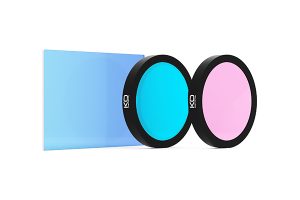
Precision optics play a major part in fluorescence microscopes. As explained in our recent blog, Fluorescence Microscopy and the Optical Components that Make It Possible , the three main optical elements – excitation filters, emission filters and dichroic mirrors – facilitate high-contrast imaging, allowing the user to accurately analyse biological behaviour in live or fixed samples, such as cell migration, protein localisation and enzyme activity.
These optics are often provided as fluorescence filter sets. Specifically designed to interact with certain fluorophores, they’ve been grouped by their spectral characteristics to effectively isolate emissions from fluorescent proteins and probes while reducing interference.
How Each Component Functions
These optics are designed to fit within special filter cubes that are integrated into fluorescence microscopes. Inside these cubes, a dichroic mirror/beamsplitter sits at 45º. Meanwhile, the excitation filter is mounted where the light enters on one side and the emission filter is fitted on the other, where fluorescence exits towards the detector.
Here’s how they operate individually:
Excitation Filter
Excitation filters – or as they’re sometimes referred to, ‘exciter filters’ – select the wavelengths necessary to excite the fluorophore under investigation. Thanks to their targeted spectral range, which blocks unwanted bands, these filters enable a clear distinction between the fluorescent specimen and the dark background.
Dichroic Mirrors/Beamsplitters
Dichroic mirrors/beamsplitters also have selective spectral performance, making them equally essential in fluorescence imaging. They reflect excitation light toward the subject while simultaneously transmitting emission light to the detector. Essentially, this separates the bright excitation light from the weaker emission signals, which, again, contributes to creating the high-contrast, clear views that are needed for accurate analysis in this field.
Emission Filters
Positioned after the sample and before the detector, emission filters block remaining excitation light and stray signals. This ensures only fluorescence reaches the camera or eyepiece, maximising the signal-to-noise ratio and giving users greater confidence in their readings.
Matching Filter Sets to Fluorophores
Every fluorophore has specific excitation and emission wavelengths, so choosing the right filter sets for your imaging scenario is vital for spectral performance. For instance, if you pick an FITC filter set for a DAPI-stained sample, you’ll end up with excitation wavelengths that mismatch, preventing the fluorophore from glowing.
At Knight Optical, our fluorescence filter sets cover common fluorophores from blue to far-red.
These include:
- DAPI (blue)
- FITC (green)
- YFP (yellow/green)
- TRITC (orange/red)
- ROX (red)
- CY5 (far-red).
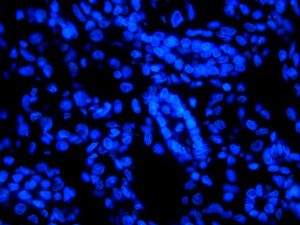
In modern-day fluorescence applications, turrets can hold multiple fluorescence filter cubes, each containing different optical combinations, so researchers can quickly switch between spectral ranges depending on the fluorophore they need to illuminate.
Meanwhile, in multi-label experiments, opting for filter sets with minimal spectral overlap will help prevent bleed-through between channels and ensure each fluorophore is captured clearly.
Stock & Custom Filter Sets
At Knight Optical, our fluorescence filter sets consist of a mounted excitation and emission filter – available in 25mm diameters – and a 25.7 x 36mm dichroic beamsplitter. While our stock catalogue has been developed to work with standard fluorophores and more routine fluorescence imaging applications, we also offer solutions for setups that have more niche criteria.
Our custom optical filters can satisfy dimensional requirements, support less common fluorophore types, target specific wavelengths or integrate with OEM systems.
What to Look for in Fluorescence Filters
When evaluating fluorescence filter sets, opting for hard-coated varieties means longer-lasting, more durable components than softer-coated variants. It’s also important to source filters with high transmission efficiency, as this will provide brighter images and shorter exposure times in fluorescence microscopes. Strong spectral performance is just as vital in keeping optical noise out of your results.
But it’s not just about the technicalities. Quality plays a key role in high-performing microscope-based imaging and should be at the top of your list of priorities when specifying optical components. At Knight Optical, our filter sets are tested in our in-house metrology laboratory by trained technicians prior to being sent to our QA department for visual inspection. These quality steps ensure your components perform as expected and are of the highest standards, so they meet the discerning demands associated with fluorescence imaging.
For further information on our stock and custom-made fluorescence filters or to discuss your fluorescence imaging system, get in touch with a member of our team today.