

The role of IR-cut filters in HUD optical performance
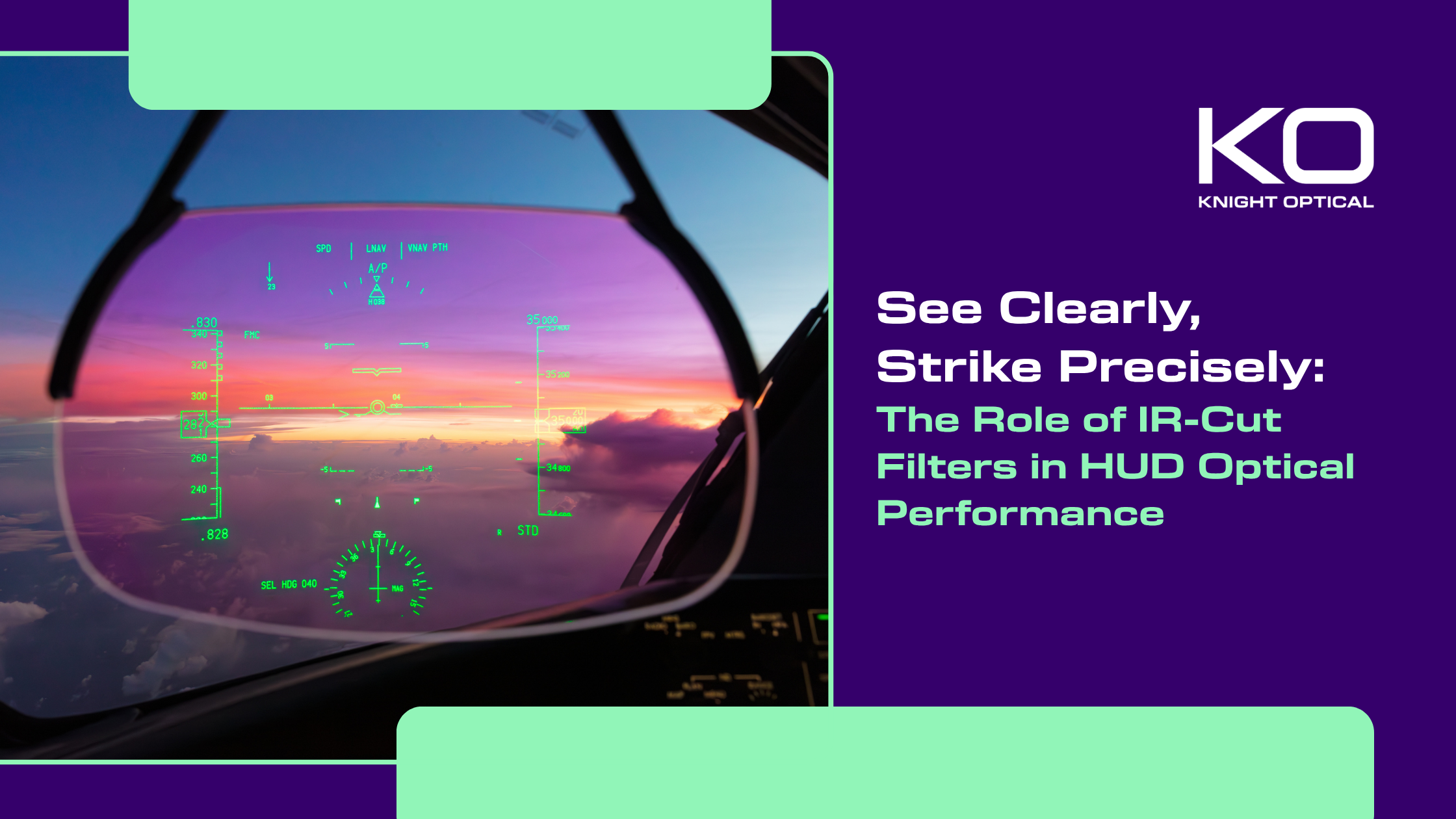
 A heads-up display (HUD) is only as good as the image it projects. Every component in the optical path contributes to image quality, ensuring symbology remains sharp, colour accurate, and legible under changing lighting conditions. Unwanted infrared light can compromise that performance by reducing contrast and altering colour balance, often without an obvious underlying cause. For this reason, IR-cut filtration should be considered a core optical requirement rather than an afterthought in the design process.
What is an IR-cut filter?
An IR-cut filter transmits visible light in the 400–700 nm range while blocking or reflecting UV and near-infrared wavelengths.
While IR-cut filters and hot mirrors both separate visible and near-infrared wavelengths, IR-cut filters are typically specified for applications where spectral precision and colour accuracy are critical, whereas hot mirrors are primarily used to reduce thermal loading.
An IR-cut filter is engineered to create a precise spectral transition, transmitting visible wavelengths while strongly attenuating near-infrared light.
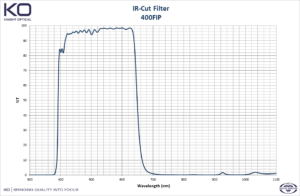
IR-Cut Filter Transmission
IR-cut filters are widely used in CCTV, machine vision, microscopy, and HUD systems where accurate colour reproduction and image clarity are essential.
HUD systems require precise control of the optical path to maintain image quality and colour fidelity. Any unwanted near-infrared light reaching the optical system can reduce contrast and alter colour balance. The challenge is compounded in cockpit and vehicle environments, where optical components must continue to perform under significant thermal loads from sunlight, engines, and instrument panels.
The engineering behind effective IR-cut performance
The coatings that make this possible are built from multi-layer dielectric thin films, often only tens of nanometres per layer, which use constructive and destructive optical interference to control precisely which wavelengths transmit and which get reflected. Achieving the required cut-on/cut-off wavelength and maintaining a sharp transition depends on the design and deposition of those layers.
A few factors matter more than they might first appear:
- Angle of incidence. A filter designed for a specific angle (45° is a common reference point) will perform differently if the actual light path hits it at another angle. This is directly relevant to HUD geometry, where light rarely strikes the optic head-on. Specifying the filter for the actual angle it will see in service, not a generic reference angle, is essential.
- Polarisation sensitivity. Coatings behave differently depending on the polarisation state of the light, and this effect becomes more pronounced at higher angles of incidence. If any portion of the HUD optical path involves polarised light, that requirement should be defined during specification rather than identified during testing.
There’s also a practical procurement argument here. A properly specified IR-cut filter can allow designers to use a more general-purpose sensor rather than sourcing a highly specialised sensor built to reject IR natively. The filter does the selective work, which opens up sensor choice and can meaningfully simplify sourcing and cost.
Consequences of inadequate IR filtration
Incomplete IR blocking leads to inaccurate colour reproduction. If unwanted wavelengths reach the sensor, they can be recorded alongside the intended signal, reducing colour fidelity and image accuracy.
Translate that into a HUD context and the symptoms are recognisable: washed-out symbology, false glare, or reduced contrast, particularly under bright sunlight or elevated thermal conditions, where maintaining image clarity becomes more challenging.
Knight Optical can provide precision IR-cut filters, with custom coatings available to meet MIL-spec requirements where needed. Angle-of-incidence and polarisation performance can be characterised against the customer’s actual optical geometry, rather than a generic reference case, so the filter performs as specified once it’s in the system it was designed for.
If you’re specifying IR-cut filtration for a HUD or similar demanding optical path, our technical sales team can work through the geometry and thermal requirements with you directly. Submit an enquiry today.