

Managing heat in optical systems: How hot and cold mirrors improve performance
 Most optical engineers spend their design time optimising visible-light performance: resolution, contrast, and colour accuracy. Infrared (IR) radiation rarely gets the same attention, yet it’s often the hidden cause of performance problems that show up later as noise, drift, or components failing earlier than expected.
Whether you’re designing a machine vision system, microscope, projector, medical device, or scientific instrument, excess infrared energy in the optical path can introduce performance limitations that may not become apparent until later in development or operation: increasing detector noise, causing sensor drift, reducing measurement accuracy, heating sensitive optical elements, shortening component lifespan, and degrading image quality overall.
In many cases, thermal issues can be addressed through optical filtering, with hot and cold mirrors providing a straightforward means of controlling IR energy within the system.
Understanding where the heat comes from
Many common light sources emit substantial infrared radiation alongside the visible wavelengths required for imaging or illumination. Halogen lamps, xenon lamps, tungsten lamps, solar illumination, and some high-power LED systems all fall into this category. Although invisible, IR radiation carries thermal energy that is absorbed by optical, mechanical, and detector components throughout the system.
For example, a machine vision camera may only need visible wavelengths to form a usable image, but if nothing in the optical path is managing infrared, that light reaches the detector anyway, contributing additional thermal loading and – depending on the detector architecture – unwanted signal response.
How IR radiation affects optical systems
Reduced imaging performance: Most image sensors exhibit increasing dark current and thermal noise as temperature rises. In practice, that means a lower signal-to-noise ratio, reduced image contrast, measurement instability, and more frequent recalibration. This matters particularly in machine vision, metrology, scientific imaging, and microscopy, where measurement repeatability and accuracy are critical.
Thermal drift: Precision optical systems depend on stable alignment, and heat undermines that stability. It can cause mechanical components to expand, shift focus, introduce alignment errors, and change the effective optical path length. Even small thermal effects can matter a great deal in high-precision applications.
Reduced component lifespan: Excess heat stresses sensors, LEDs, optical adhesives, filters, and coatings over time. Managing thermal load is not solely a performance consideration; it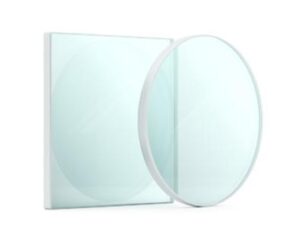 also plays an important role in long-term system reliability.
Hot mirrors: keeping IR out
A hot mirror is a dielectric-coated optic that transmits visible light while reflecting IR wavelengths. It lets useful illumination through while redirecting unwanted heat away from sensitive components downstream. Positioning a hot mirror upstream of the detector allows visible wavelengths to pass while reflecting infrared radiation away from the optical path, reducing thermal loading on downstream components.
Hot mirrors are typically found in machine vision cameras, scientific instruments, medical imaging systems, display systems, and industrial inspection equipment. Depending on the system architecture, the result can be lower detector temperatures, improved measurement stability, and reduced thermal drift.
Cold mirrors: removing heat from illumination systems
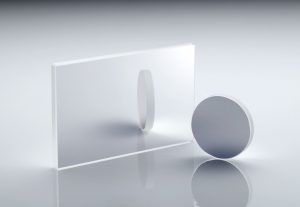 A cold mirror performs the opposite function. It reflects visible light while transmitting infrared. That makes it useful where you want to direct visible illumination toward a target while letting the heat-producing infrared radiation pass straight through the mirror and out of the system, rather than travelling with the visible beam toward the illuminated target.
Cold mirrors are used in microscopy, projection systems, surgical lighting, spectroscopy, and industrial illumination. In a microscope, a cold mirror can reflect the visible light needed for observation while allowing the heat-generating IR radiation from the light source to exit the optical path instead of building up around the sample. The primary benefits include
reduced heat at the target, more comfortable illumination for operators, protection of heat-sensitive samples, and improved system efficiency overall.
Hot mirror or cold mirror: which one do you need?
The selection depends primarily on where infrared energy needs to be removed from the optical path.
| Requirement | Recommended solution | |
|
Hot mirror | |
|
Cold mirror | |
|
Hot mirror | |
|
Cold mirror | |
|
Hot mirror | |
|
Cold mirror |
Key specifications to consider
Wavelength range: What exactly needs to be transmitted or reflected? A typical requirement might specify visible transmission across 400–700 nm alongside IR reflection from 700–2500 nm, but the precise bands should always be matched to your light source and detector, not assumed.
Angle of incidence (AIO): Performance can change significantly depending on the angle at which the optic operates. Specify clearly whether the system uses 0°, 45°, or a custom angle, since a mirror designed for one will not perform identically at another.
Because hot and cold mirrors rely on multilayer dielectric coatings, their spectral performance shifts with angle of incidence. A coating optimised for 45° may exhibit significantly different transmission and reflection characteristics at normal incidence, making AOI one of the most important specification parameters during selection.
Spectral performance: Reflectance and transmittance should be evaluated across the full operating wavelength range to ensure unwanted infrared leakage and optical losses remain within acceptable limits.
Surface quality: Critical wherever imaging accuracy, precision measurement, or laser applications are involved, where even minor surface defects can affect results.
Environmental durability: Consider the humidity, temperature cycling, and cleaning requirements the optic will face in actual service. A mirror that performs well on the bench needs to keep performing after months of real-world use.
Real-world applications
- Machine vision: Reducing detector heating and improving measurement stability.
- Microscopy: Reducing heat reaching sensitive biological samples.
- Medical devices: Managing heat while maintaining high illumination levels.
- Scientific instrumentation: Limiting temperature-induced measurement drift.
- Projection systems: Directing visible light efficiently while reducing thermal load.
Selecting a hot or cold mirror requires consideration of wavelength range, angle of incidence, coating performance, substrate material, and environmental conditions. We supply standard and custom-coated hot and cold mirrors, and can provide technical guidance on specification selection for both prototype and production applications. All components are supplied with inspection and testing appropriate to the specified requirements.
Thermal management is an important consideration in optical system design, particularly where detector stability, measurement accuracy, or component lifetime are critical.
By selectively managing infrared radiation, hot and cold mirrors provide an effective way to reduce thermal load without compromising optical performance. Hot and cold mirrors provide a practical method of controlling infrared energy within an optical system, allowing thermal effects to be addressed without significantly affecting visible-light performance.
Where thermal loading is affecting system performance, evaluating the infrared content of the optical path can often identify opportunities for improvement through optical filtering.
Contact our technical team today to discuss your requirements.