
When should you use aspheric lenses in machine vision systems?

Machine vision systems are expected to capture sharp, repeatable images for inspection, measurement, identification, and automated decision-making. As image quality requirements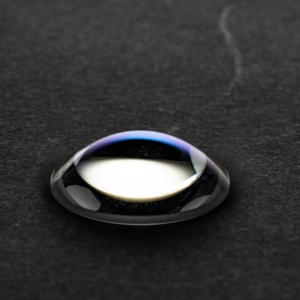 become more demanding, optical designers often face a common question: should the system incorporate aspheric lenses?
While spherical lenses remain widely used, they can introduce optical aberrations that limit imaging performance. Aspheric lenses offer greater control over how light is focused within an optical system and can often achieve the required optical performance with fewer elements.
We regularly work with customers who specify aspheric lenses to reduce spherical aberration and simplify optical designs where size, weight, or lens count are important considerations.
The key question is not whether aspheric lenses are better than spherical lenses, but when they are the right choice for a machine vision application.
What makes an aspheric lens different?
A conventional spherical lens has a constant curvature across its surface. While spherical optics are often simpler to manufacture, they can introduce aberrations that affect image quality.
An aspheric lens differs because its curvature changes across the lens surface. This variation allows optical designers to optimise how light rays are focused, giving greater control over lens performance and reducing optical errors that can occur in spherical designs. The profile of an aspheric lens is defined by a mathematical surface description, giving designers greater control over how light is focused within the system.
When spherical aberration limits image quality
In a traditional spherical lens, light rays entering at different points on the lens may not converge at the same focal point. This optical effect, known as spherical aberration, can reduce sharpness and image quality.
Aspheric lenses are designed to minimise this effect by controlling how light is refracted across the lens surface, resulting in sharper images and more accurate focus across the field of view.
For machine vision systems performing measurements, inspections, or feature recognition, improved image quality can directly support more reliable results.
When a compact optical system is required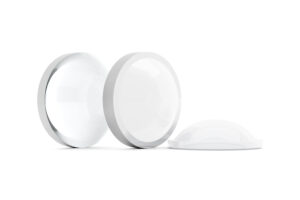
Machine vision systems are increasingly being integrated into environments where space is limited. Robotics platforms, smart sensors, autonomous systems, and embedded vision devices often require compact optical assemblies without compromising performance.
This is one area where aspheric lenses are often specified. A single aspheric surface can often replace two to five or more spherical elements, which reduces system size, weight, and assembly complexity while maintaining the required optical performance.
For engineers designing vision systems for robotics and automation, reducing lens count can simplify assembly, reduce alignment requirements, and help minimise overall system size.
When high-precision inspection is needed
Many machine vision systems are designed to identify small defects, verify assemblies, or perform dimensional measurements. In these applications, image quality is critical.
Any loss of sharpness can affect contrast, edge detection, and the ability to accurately distinguish fine features.
By reducing aberrations and improving focus, aspheric lenses can help produce sharper images and improve measurement accuracy in demanding inspection applications.
This can be particularly valuable in:
· Automated Optical Inspection (AOI)
· Precision measurement systems
· Machine vision quality control
· Multi-camera inspection platforms
· Imaging systems based on CCD and CMOS sensors
Beyond spherical aberration
 Although spherical aberration is often the primary reason for selecting an asphere, it is not the only optical challenge that can be addressed.
Aspheric lenses can also help minimise aberrations including coma and astigmatism. In conventional optical systems, addressing these issues frequently requires additional lens elements. An aspheric design can provide a more streamlined solution while maintaining the required imaging quality.
For machine vision systems that rely on accurate measurements or defect detection, controlling aberrations across the field of view can be just as important as achieving sharp focus at the centre of the image.
Applications in robotics and automation
Robotics and automation systems often combine tight space constraints with demanding imaging requirements.
In these applications, aspheric lenses are often specified to maintain image quality while helping to reduce overall system size and complexity.
For engineers developing vision-guided robots, autonomous mobile robots (AMRs), and automated inspection systems, this can simplify optical integration where space and weight are limited.
Material and manufacturing considerations
Not all machine vision applications operate within the visible spectrum. Depending on the imaging requirements, systems may utilise ultraviolet, visible, or infrared wavelengths.
We can supply aspheric lenses in a range of materials including optical glass, silicon, chalcogenides, and zinc selenide, supporting applications across UV, visible and infrared wavebands.
Through our parent company, Torrent Photonics, we support projects requiring high-precision aspheric optics and can advise on the most suitable manufacturing approach for a given design.
· Precision moulded aspheric lenses
· Plastic aspheric lenses
· Fire-polished aspheric lenses
· Diamond-turned aspheric lenses
· CNC-manufactured custom aspheres
This provides greater flexibility when specifying an asphere for a particular application.
Design considerations
Many optical designers still associate aspheric optics with high cost and long lead times. Advances in fabrication and metrology have changed this significantly, making aspheres a practical option for many applications that would previously have relied on spherical optics.
When a single asphere can replace multiple spherical elements, reductions in lens count, assembly complexity, and system size may offset the additional cost of the optic itself.
When should you consider an aspheric lens?
An aspheric lens may be worth considering when an optical system is experiencing one or more of the following challenges:
· Image quality is limited by spherical aberration.
· The design requires a reduction in lens count.
· Space or weight constraints restrict system size.
· High-resolution imaging is required.
· Optical performance must be maintained across a wider field of view.
· Inspection accuracy depends on maximising image sharpness.
While spherical optics remain suitable for many applications, aspheric designs can offer significant advantages when performance and compactness become key design drivers.
Conclusion
Aspheric lenses are often worth evaluating when conventional spherical optics can no longer meet the imaging requirements of a machine vision system.
If the goal is improved image quality, a more compact optical design, or fewer optical elements, aspheres can provide additional design flexibility while helping to maintain the required system performance.
Whether you’re developing a new machine vision system or refining an existing optical design, we can help identify the most suitable aspheric lens solution for your application through our partnership with Torrent Photonics.
For further information, contact [email protected].