

The role of optical lenses in video spectral comparators for forensic analysis
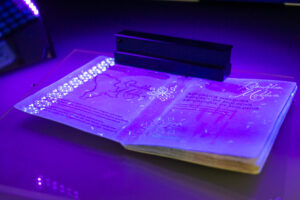
Video spectral comparators (VSCs) let forensic document examiners see hidden text, alterations and security features so subtle they’re invisible to the naked eye. By combining ultraviolet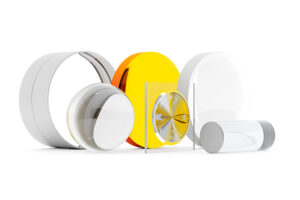 (UV), visible (VIS) and infrared (IR) light sources, these instruments reveal how inks, paper substrates, passports and banknotes respond across different spectral bands, and it’s the optical components inside the VSC that decide exactly what the operator can resolve.
Since the technology entered forensic laboratories in the late 1970s, the spectral range on offer has grown enormously: modern systems commonly sweep from around 200 nm in the UV to beyond 1000 nm in the near infrared, across dozens of individually selectable light sources.
In cases involving ‘questioned documents’, which include things like wills, IDs, currency and even threatening letters where authenticity or content is disputed, examination must be non-destructive. This is because chemical treatments or physical sampling risk damaging evidence that may later need to stand up in court. VSCs make this possible by imaging documents without marking or altering them and exposing information the human eye can’t detect. In these systems, it’s the optics, and more specifically the lenses – that that affect the amount of detail the examiner can accurately observe.
What is a video spectral comparator?
A VSC is a digital imaging system that combines a high-resolution camera with magnifying optical components, filters and multiple light sources spanning UV, VIS and IR wavelengths. A typical configuration includes narrowband UV sources peaking around 365 nm, 312 nm and 254 nm, broadband incandescent or LED illumination extending toward 1000 nm, and specialised sources such as anti-Stokes excitation around 970–990 nm for reading certain passport security inks. Two inks that look identical in daylight can behave very differently under IR light: one may vanish from the image entirely while the other stays dark.
Because different inks, papers and anti-counterfeiting marks absorb, reflect or fluoresce differently at each wavelength, analysts switch between light sources to make these differences visible. VSCs are therefore commonly used to recover erased or obliterated writing, distinguish between visually identical inks, and authenticate security features such as watermarks, fluorescent fibres and microtext in identity documents and banknotes. This is the process used to detect forgeries like altered figures on a cheque.
How lenses deliver image clarity
Although light uncovers the evidence, it’s the lens that sets the ceiling on what an examiner can extract from it. Security features such as microprinting (text deliberately sized small enough to defeat standard photocopying and scanning) need to be captured cleanly at maximum zoom, which demands both high magnification and strong resolving power from the lens.
Because examiners frequently compare materials side by side, low distortion is equally critical: if a lens introduces barrel or pincushion distortion, legitimate and questioned samples can’t be overlaid reliably for comparison. Meeting these demands typically calls for precision optical lenses specified to tight surface and centration tolerances. Knight Optical’s own spherical and aspheric lens capability, for example, routinely holds form error below 0.5 fringes and centration below 3 arc minutes, with surface quality to 60/40 scratch-dig, compensating for the aberrations that would otherwise soften fine detail.
Spectral accuracy, transmission ranges and coatings
 Sharpness alone isn’t enough. A lens also needs to transmit evenly from the VIS band through to the NIR (roughly 400 – 1000 nm, and further into the UV for some applications). If parts of that range have a lower transmission than others, cross-band comparisons are skewed.
In addition, there is a focus shift to manage. Because a material’s refractive index varies with wavelength, different colours of light come to focus at slightly different distances, so a lens that’s sharp in the VIS can be soft in the IR. Achromatic lenses, typically cemented doublets pairing a high-index flint element with a low-index crown element, bring two chosen wavelengths (commonly red and blue) to a common focus; apochromatic triplets extend that correction across three wavelengths. Either approach keeps focus consistent from one spectral band to the next, which matters when the entire technique depends on comparing images captured at different wavelengths.
Anti-reflective (AR) coatings are applied to preserve what little light is available, which matters most for fluorescence work. Fluorescence signals are often faint, so flare and ghost reflections from uncoated surfaces can wash them out; broadband AR coatings help maintain contrast across the full operating range and can be tuned to specific bands where a system relies on narrowband illumination.
Specifications like these often suit custom-made lenses built to exact transmission ranges, correction levels and coating specifications, including achromatic designs where off-the-shelf optics fall short.
Watch: Optical Lenses
To find out more about the optical lenses, watch our video below. Be sure to visit our YouTube channel and subscribe for more videos on optical components and how they’re utilised by some of the world’s morst critical industries.
Precision lenses for forensic imaging
In investigative applications, findings are only as reliable as the images they’re based on. That reliability depends on the performance of every lens in the imaging path.
At Knight Optical, our lenses are metrology-tested and quality-assured.
Radius of curvature and surface irregularity are verified on a Zygo Verifire interferometer, focal length and centration error are checked on Trioptics OptiSpheric and OptiCentric instruments, and coatings are measured on Agilent Cary 7000 and Cary 660 FTIR spectrophotometers across multiple angles of incidence and polarisation states.
All optics are 100% visually inspected to ISO 10110 and MIL-O-13830A standards. Backed by our ISO 9001-accredited processes, every optic is checked against its requirements before it’s dispatched.
To talk to us about the right lens type, substrate, coating and tolerance for your application, contact a member of our technical sales team today.