

Custom or stock? A guide to choosing the right optical lens
One of the earliest and most important decisions in optical system design is whether to use a stock lens or commission a custom optic. This choice influences cost, lead time, optical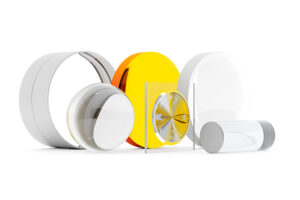 performance, and long-term manufacturability, and is largely driven by the demands of the application. Many imaging, sensing, and illumination systems can achieve their objectives using catalogue optics, providing a cost-effective and readily available solution.
However, as optical, mechanical, or environmental requirements become more demanding, the limitations of standard components can become apparent. Relying on a stock lens that cannot fully meet the system requirements may lead to performance compromises or costly redesigns, while specifying unnecessarily tight tolerances in a custom optic can increase costs without delivering meaningful benefits. Selecting the most appropriate approach early in the design process helps minimise risk, control development costs, and ensure the optical solution is well matched to the application’s needs.
Start with the application
The best starting point is not whether a lens is stock or custom, but what the system actually needs to achieve.
 Factors such as image quality, transmission, field of view, operating wavelength, and available space all play a role in lens selection. If a standard lens meets those requirements, there is little benefit in adding the cost and lead time associated with a custom design.
Stock lenses are available in a wide range of common geometries, including plano-convex, plano-concave, achromatic, aspheric, cylindrical, and Fresnel designs. Because these products are manufactured in standard dimensions and focal lengths, they are often the quickest and most economical route to a working optical system.
As performance requirements become more specific, however, standard components can become limiting. A custom lens allows parameters such as focal length, surface figure, centration, coatings, material selection, and dimensional tolerances to be tailored to the application rather than constrained by catalogue availability.
When a custom lens makes sense
Mechanical integration is often one of the main reasons for moving beyond stock optics. Standard lenses are only available in fixed diameters, thicknesses, focal lengths, and edge profiles, which may not suit an existing housing, detector package, or compact optical assembly.
However, geometry is only one part of the equation. Custom optics are frequently specified when tighter control over optical performance is required. While stock lenses are manufactured to suit a broad range of applications, some systems demand specifications that go beyond standard catalogue tolerances. This may include tighter control of focal length, surface figure, centration, surface quality, wedge, transmitted wavefront error, or dimensional tolerances. These factors become increasingly important in high-resolution imaging, laser systems, metrology equipment, semiconductor applications, and other systems where even small optical errors can affect overall performance.
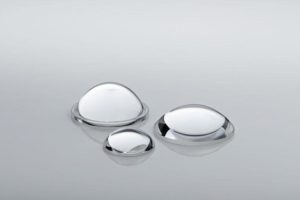
Material choice can also drive the need for a custom solution. While many stock lenses are manufactured from common optical glasses, applications operating in the ultraviolet or infrared may require materials such as UV fused silica, calcium fluoride, silicon, germanium, sapphire, or other specialist substrates. A custom lens allows the material to be selected specifically for the refractive index, dispersion, operating wavelength range, environmental conditions, transmission requirements, or thermal performance.
Coatings are another consideration. Standard anti-reflection coatings are suitable for many applications, but systems operating within a specific wavelength range can often benefit from coatings optimised for their exact requirements. In more demanding environments, additional coating options such as diamond-like carbon (DLC), hydrophobic, anti-fog, oleophobic, conductive indium tin oxide (ITO), or high laser-damage-threshold coatings may be required to improve durability, environmental resistance, or optical efficiency.
Custom optics also provide greater flexibility in lens form and optical function. While spherical lenses are suitable for many applications, more specialised systems may require aspheric lenses to reduce aberrations, cylindrical lenses to focus light in a single axis, axicons to generate extended-depth-of-focus or ring-shaped beams, or Fresnel lenses to achieve large apertures with reduced weight. In these cases, the lens geometry becomes an integral part of the optical design rather than simply a standard component selected from a catalogue.
Define the requirements early
Whether selecting a stock component or developing a custom optic, a clear specification is essential. The optical performance required by the system should ideally be established during the design phase, with targets such as image quality, MTF, spot size, wavefront error, transmission, field of view, distortion, and operating wavelength range clearly defined. These performance requirements ultimately determine the design of the lens and the manufacturing tolerances needed to achieve it.
Once the optical design has been finalised, the manufacturing drawing should clearly communicate the specifications required to produce and verify the component. ISO 10110 provides a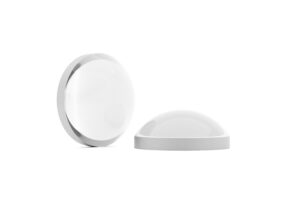 common framework for defining these characteristics and helps ensure both the customer and manufacturer have a shared understanding of the requirements.
Before submitting an enquiry or manufacturing drawing, consider specifying the following:
- Material: The substrate from which the lens is manufactured, including any requirements for refractive index, Abbe number, homogeneity, birefringence, inclusions, bubbles, or striae where applicable.
- Dimensions: Lens diameter, centre thickness, edge thickness, clear aperture, chamfers, edge treatments, and associated dimensional tolerances.
- Surface form (Figure): The permitted deviation of the optical surface from its nominal shape. Typically specified as peak-to-valley, fringes, RMS, or power and irregularity values depending on the application.
- Surface quality: Cosmetic surface defects such as scratches, digs, pits, sleeks, and blemishes. Usually specified using scratch-dig or equivalent standards in accordance with ISO 10110-7.
- Centration: The alignment of the optical axis relative to the mechanical axis of the component. Poor centration can introduce beam deviation, image shift, and alignment difficulties within the optical assembly.
- Surface texture (Roughness): Surface microroughness requirements that can influence scatter, transmission, coating performance, and laser-induced damage thresholds.
- Wedge and parallelism: The allowable angular deviation between opposing surfaces, particularly important for windows, filters, and plano optics where beam steering must be minimised.
- Coating specification: Coating type, operating wavelength range, angle of incidence, environmental durability requirements, and optical performance targets such as reflectance, transmission, or absorption.
- Laser damage threshold (where applicable): For laser systems, define any requirements for LIDT performance under specified wavelengths, pulse durations, and fluence levels.
- Environmental requirements: Operating temperature range, humidity exposure, vibration, shock, chemical resistance, or other environmental conditions that may influence manufacturing, material selection, or coating design.
- Inspection and acceptance criteria: Any interferometric testing, transmission measurements, coating certification, material certification, certificates of conformity, or metrology reports required with delivery.
- Quantity and lead time: Prototype and production volumes, as these can significantly influence manufacturing method, tooling investment, achievable tolerances, and overall cost.
A supplier can often provide a quotation from a limited specification, but any undefined parameters will typically be based on standard manufacturing assumptions. Clearly defining drawing requirements at the outset helps ensure the optic can be manufactured, inspected, and qualified consistently, while avoiding unnecessary cost, over-specification, or performance risk.
Balancing cost, performance and availability
There is no universal answer to the stock-versus-custom question.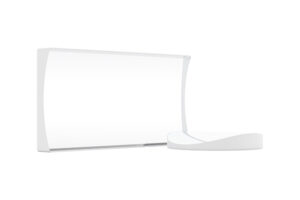
Stock lenses offer shorter lead times, lower upfront costs, and proven availability, making them an excellent choice for many prototype and production applications. Custom lenses become worthwhile when a design requires specialised materials, non-standard dimensions, enhanced optical performance, tighter manufacturing tolerances, or coatings that are not available as standard.
In reality, many optical systems use a combination of both. A design may incorporate a stock lens with a custom coating, a modified catalogue optic, or a fully custom lens alongside standard components. The important thing is to assess each optical element against its individual optical, mechanical, and environmental requirements rather than treating the entire system as either stock or custom.
If a catalogue lens meets the specification, it is usually the simplest and most cost-effective option. If it does not, a well-defined custom solution can deliver the required performance without unnecessary compromise.
To discuss your stock or custom optical lens requirements, contact the Knight Optical technical sales team at [email protected].