

How Precision Optics Shape the Future of Environmental Monitoring
Climate science, biodiversity change, wildfire detection, atmospheric analysis, and ice and snow cover all depend on Earth observation (EO) satellites that employ remote sensing instruments to inform policy, conservation and emergency response. According to the European Space Agency (ESA) Climate Office, of the 55 Essential Climate Variables (ECVs) used to track the planet’s climate, around 60% can be observed from space, and optical components are shaping how these datasets are acquired both now and in the future.
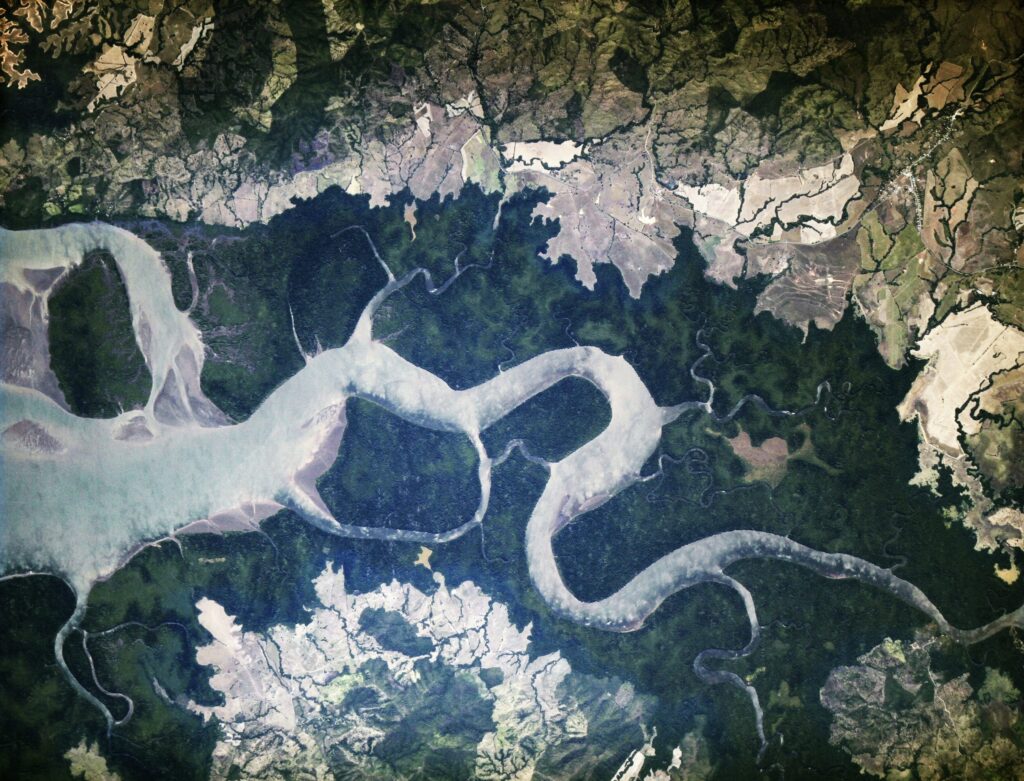
With a broader, more repeatable global scope than drone-based remote sensing systems, satellite EO provides various types of information for environmental monitoring, each suited to different purposes. For example, panchromatic or true-colour imagery is preferable for fine spatial detail and visual mapping, including land cover, urban change and disaster-damage assessment, whereas multispectral and hyperspectral imaging are suited to analysing vegetation, water, minerals and environmental conditions. And while synthetic aperture radar (SAR) excels at penetrating cloud cover, day or night, light detection and ranging (LiDAR) is better for atmospheric monitoring, terrain elevation, and 3D modelling.
Stable, Distortion-Free Imaging from Orbit
The imaging chain varies by platform, too. Larger-scale platforms tend to use telescope designs with precision mirrors, whereas smallsats and CubeSats generally use refractive lenses. Both configurations require protective windows or domes to shield the aperture and sensor while simultaneously maintaining broad transmission.
This is often achieved with anti-reflective (AR) coatings to reduce reflections and suppress stray light and ghosting, yielding a cleaner signal. Distortion-free surfaces are equally important; because surface form and wavefront errors can degrade clarity before observations are even captured, optics should be measured with interferometers and profilometers to verify they meet specifications.
Surviving the Orbital Environment
Optical domes, windows, and coatings for spacecraft and sensors must be designed to withstand some of the most hostile operating environments, a task that depends on deliberate substrate and coating choices from the outset. For instance, ionising radiation causes glass to brown, meaning suitable substrates need to be chosen to resist it – usually fused silica. Thermal cycling, especially for low Earth orbit (LEO) spacecraft, which cross in and out of Earth’s shadow roughly every 90 to 120 minutes, demands optical components such as domes, which offer dimensional stability under extreme temperature swings. The hard vacuum of space requires low-outgassing materials and bonding adhesives that won’t release volatiles that can condense on, and subsequently degrade, optics.
Coatings also play their part, with hard layers such as diamond-like carbon (DLC) protecting softer infrared (IR) materials like germanium from abrasion.
Spectral Discrimination for Environmental Data
Wavelength-based discrimination is becoming central to EO as operators push for detail that broadband image acquisition can’t resolve and constellations of smallsats widen coverage, imaging more of the world at higher revisit rates. Going beyond standard RGB imagery, multispectral imaging (MSI) and hyperspectral imaging (HSI) capture spectra in far greater detail than a conventional camera, measuring across bands that reveal the composition or condition of targets below.
However, the two differ in how finely they slice the spectrum:
Multispectral Imaging
MSI relies on a handful of discrete broad bands isolated by interference bandpass filters, while dichroic mirrors and beamsplitters route the bands to sensors, enabling the system to feed vegetation and biodiversity indices, fire detection, cryosphere monitoring and broad climate indicators.
Hyperspectral Imaging
HSI works differently by capturing hundreds of contiguous narrow bands via a dispersive optic – typically a grating or prism. This fine spectral resolution allows HSI to distinguish subtle differences, so it’s frequently deployed for applications like atmospheric trace-gas identification, mineral and biodiversity mapping and vegetation water stress.
For each approach, the quality of the optical component drives reliability. For filters in MSI, out-of-band leakage allows unwanted wavelengths to reach the sensor, skewing derived index maps, whereas in HSI, unwanted light and crosstalk produced by dispersive optics blur the spectral detail the technique relies on.
Optical Components for Earth Observation
High-precision, metrology-tested optical components turn observations from orbital platforms into actionable environmental data. As EO reaches for finer spectral and spatial resolution, the performance of the optics behind it matters more than ever.
To discuss your optical component specification or to learn more about our custom optics for aerospace, engineered and metrology-tested to withstand the rigours of space, contact a member of our team today.