
How reticle fabrication method affects optical performance

Reticle performance depends on more than pattern geometry and dimensional accuracy. The fabrication method used to create the pattern can affect contrast, transmission, durability and spectral behaviour, making it an important consideration during the design stage rather than a manufacturing detail left until the end.
Four fabrication methods cover most reticle and graticule applications: etch and fill, unfilled etched, metallic and dichroic.
What influences reticle performance?
Pattern geometry is only part of the specification. Fabrication method can influence:
- Contrast under different illumination conditions
- Light transmission through the optical system
- Resistance to handling and cleaning
- Long-term performance in harsh environments
- Behaviour across different wavelengths
The importance of each factor depends on the instrument and operating environment.
Etch and fill reticles
Etch and fill reticles are produced by chemically etching a pattern into the substrate and filling the grooves with a coloured material, typically black, white or red.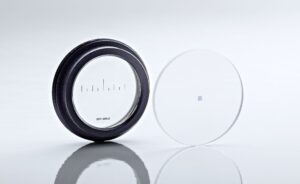
This approach provides high contrast and allows the appearance of the pattern to be tailored to the application. Black fill produces a dark feature against a bright background, while white fill can be used in illuminated reticles where light is introduced through the edge of the substrate.
Because the fill is contained within the etched grooves, it benefits from greater protection than a surface coating.
Etch and fill reticles are commonly used in optical sights, microscopes, measurement systems and general instrumentation where pattern visibility is a primary requirement.
Long-term exposure to UV radiation, elevated temperatures or aggressive cleaning can affect the filled material, so environmental conditions should be considered during specification.
Unfilled etched reticles
Unfilled etched reticles use the same manufacturing process but without the addition of a fill material.
The pattern exists as a physical structure in the substrate and is visible through refraction and scattering at the etched features.
Without pigments or coatings in the optical path, transmission remains high. This can be beneficial in low-light systems, laser applications and instruments where minimising optical losses is important.
The absence of fill materials also removes potential sources of fading, degradation or outgassing. For some applications, including vacuum environments, designers may prefer to avoid fill materials altogether.
Reduced contrast is the main drawback of this approach. Depending on illumination conditions and background content, the pattern can be less visible than an equivalent filled or metallic design.
Metallic reticles
Metallic reticles are produced by depositing a thin metal layer onto the substrate and patterning it using photolithographic techniques.
Chrome is commonly used because it provides high opacity, strong adhesion and good durability.
The resulting pattern produces very high contrast with sharply defined feature edges. This combination of contrast and durability makes metallic reticles well suited to defence, aerospace and other demanding optical applications.
Reflectance should also be considered during system design. Metallic patterns reflect part of the incident light, which can contribute to stray light or ghost images depending on the optical layout.
Compared with etched reticles, metallic patterns require additional manufacturing processes, which can increase cost and lead time.
Dichroic reticles
Dichroic reticles use wavelength-selective thin-film coatings instead of opaque features.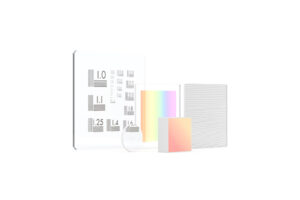
Rather than blocking light, the patterned regions reflect specific wavelength bands while transmitting others. This allows the reticle to perform differently across multiple spectral regions.
In multi-band optical systems, the pattern can be visible in one channel while remaining transparent in another. This capability is particularly valuable where several imaging or sensing functions share a common optical path.
Because the coating reflects selected wavelengths rather than absorbing them, dichroic designs can also be advantageous in applications involving higher optical power levels.
Performance depends on wavelength, angle of incidence and coating design, making specification more application-specific than the other fabrication methods discussed here.
Comparing the options
Each fabrication method offers a different balance of performance characteristics:
| Etch & fill | Unfilled etched | Metallic | Dichroic |
|
|
|
|
Selecting a fabrication method
Applications where pattern visibility is critical often use etch and fill reticles. Unfilled etched reticles are typically selected when transmission, laser compatibility or environmental stability take priority. Metallic reticles are commonly chosen for high-contrast, high-durability applications, while dichroic reticles are generally reserved for systems operating across multiple wavelength bands.
Requirements frequently overlap, making early discussion of the fabrication method valuable during system design. A pattern geometry that works well with one fabrication process may be less suitable for another, particularly where optical performance and environmental durability are both important considerations.
Matching the process to the application
The fabrication process plays a significant role in determining how a reticle performs in service. Contrast, transmission, durability and spectral behaviour are all affected by the fabrication method used to create the pattern.
Pattern geometry and fabrication method should be specified together, particularly where contrast, transmission or environmental durability are critical to system performance.
To discuss your requirements, please contact our technical sales team: [email protected].