
Scientific instruments rely on optical components that deliver precision, stability, and reliability across a wide range of wavelengths and operating environments. From benchtop analytical tools and R&D instruments to advanced imaging systems and optical benches in university laboratories, two materials frequently stand out for their versatility and performance: N‑BK7 and sapphire. Each offers a distinct combination of optical, mechanical, and environmental advantages, and Knight Optical supplies both as high‑quality stock and custom components for scientific, educational, medical and industrial research settings.
In this article, we explore why N‑BK7 and sapphire continue to be foundational materials for scientific optics, how their properties differ, and the types of components in which they are commonly used. Whether designing a new instrument or refining an existing setup, understanding the benefits of each material helps engineers and researchers select the optimal solution for their optical system.
Why N‑BK7 Remains a Scientific Workhorse
N‑BK7 is one of the most widely used optical glasses in research, educational and laboratory instrumentation. Known for its excellent transmission in the visible range, good performance into the NIR, and predictable optical behaviour, N‑BK7 offers a balanced combination of clarity, manufacturability and affordability.
Knight Optical supplies a range of lenses, windows, and prisms manufactured from N‑BK7 or Schott‑equivalent materials, supporting applications spanning microscopy, spectroscopy, imaging, metrology and automated inspection.
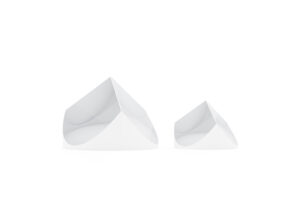 Key reasons N‑BK7 is ideal for scientific optics:
- High optical clarity across VIS–NIR makes it suitable for general-purpose imaging and detection systems.
- Excellent homogeneity and low inclusion levels ensure stable imaging performance for laboratory instruments.
- Ease of polishing and shaping enables precise control of surface figure — vital in research-grade lenses and prisms.
- Availability in many forms, including spherical/achromatic lenses, windows, beamsplitters and other standard components in our catalogue.
Because N‑BK7 offers dependable optical performance at a competitive cost, it remains an ideal choice for university departments, analytical labs, product‑development teams, and scientific OEMs requiring volume‑ready optics without sacrificing accuracy.
Sapphire Optics: Extreme Durability for Demanding Research
Sapphire (Al₂O₃) is one of the most durable optical materials available, used widely in scientific fields where mechanical robustness, environmental resistance and wide spectral transmission are priorities.
Knight Optical provides sapphire windows and lenses tailored for applications requiring high pressure resistance, thermal stability and scratch resilience; characteristics that make sapphire invaluable in high‑power laser environments, UV–IR imaging, harsh‑condition metrology, and scientific instrumentation.
Key advantages of sapphire in scientific systems: 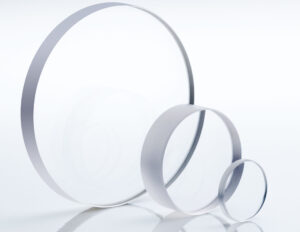
- Exceptional hardness (second only to diamond) for abrasion‑resistant windows in field instruments or ruggedised scientific devices.
- High pressure tolerance, making it suitable for high‑vacuum, high‑temperature, or high‑pressure optical viewports.
- Broad spectral range, covering UV through IR, enabling one material to support multi‑wavelength research applications.
- Superior thermal and chemical resistance, ideal for instruments exposed to solvents, heat cycling or demanding environments.
These attributes allow sapphire optics to be integrated into laboratory setups that experience mechanical wear, lasers that require protective front windows, and research systems that operate outdoors or in harsh industrial settings.
How Each Material Supports Different Scientific Disciplines
Because research environments vary greatly, from optical benches to environmental chambers to industrial inspection lines, N‑BK7 and sapphire often serve complementary roles.
N‑BK7 typically supports:
- Laboratory imaging systems
- Spectroscopy and fluorescence instruments
- Educational optical benches
- Machine‑vision and quality‑inspection systems
- General‑purpose lenses and prisms
Sapphire is often selected for:
- Harsh‑environment optical windows
- High‑power laser systems requiring robust front elements
- Pressure‑ and temperature‑dependent experiments
- Field instruments or ruggedised scientific sensors
- UV, VIS, and IR multi‑band systems
This complementary behaviour allows optical designers to choose the right material for the right optical function depending on the system’s mechanical, environmental and spectral constraints.
Scientific Optics from Knight Optical
Whether you require the broad spectral versatility of N‑BK7 or the rugged, high‑performance characteristics of sapphire, Knight Optical provides a full range of precision‑tested optical components suitable for scientific instruments at every level, from university labs to industrial R&D and advanced analytical platforms. With decades of experience, comprehensive stock availability, custom manufacturing capabilities, and advanced metrology testing, Knight Optical remains a trusted partner for scientists seeking optical components that perform consistently and accurately across demanding applications.