
The stars have been guiding travellers all over the globe for centuries. Polynesian navigators crossed the Pacific using star maps, Christopher Columbus discovered the New World through astronomical observations, and even fictional heroes like Peter Pan knew ‘the second star to the right’ would guide him home. For millennia, the twinkling lights we see above our heads in the night sky have enabled real-time navigation. Though the fundamental principles remain relatively the same, modern-day optical tracking technology has transformed this ancient practice from an art into an exact science. Here, we explain how star trackers perform, and why they call for high-specification optical components.

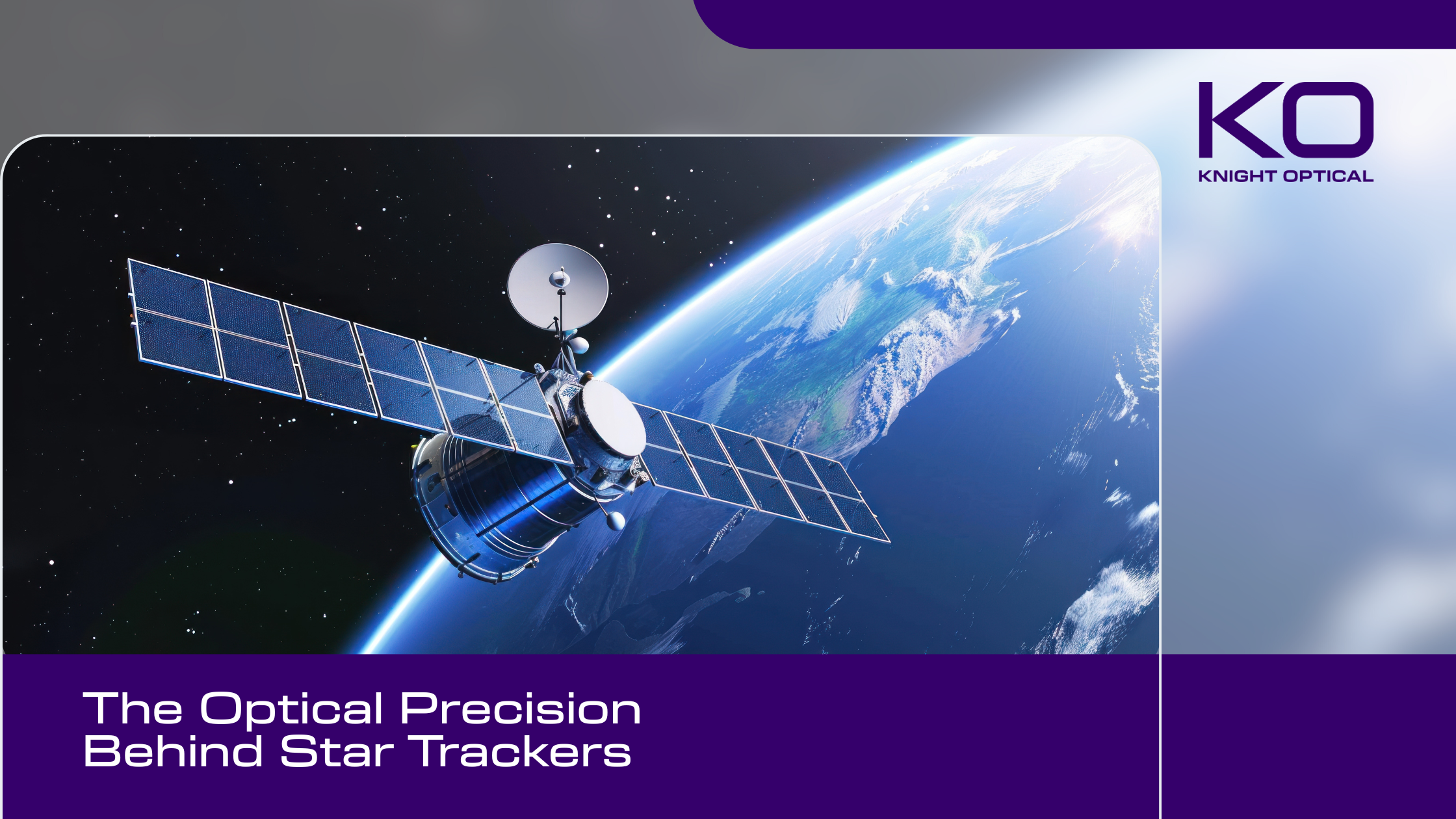
While the majority of historical wayfinding took place on the open sea, extraterrestrial exploration brought about unprecedented challenges. Introduced in the late 1940s to early 1950s, star trackers were employed for aircraft and missile guidance, helping to establish a celestial reference for position and bearing determination. These optical devices evolved as more orbital and deep-space vehicles were launched, and they’re now mounted to satellites and spacecraft, operating much like a compass on a ship. On board, they work by continuously capturing images of the star field that surrounds them, comparing patterns to a preprogrammed star catalogue and calculating a vehicle’s precise 3D orientation, termed in the aerospace industry as attitude determination (essentially, a craft’s orientation).
What Star Trackers Do
The information star trackers provide is crucial for cost-effective, successful missions. Collectively, they function to enable orbiting systems to point cameras accurately at Earth for imaging and aim communication antennas at ground stations for data transfer. Without such devices, the pinpoint positioning of satellites that makes everyday conveniences run seamlessly simply wouldn’t be possible. Given the circa 10,000 satellites revolving around Earth – and with star trackers serving as a common inclusion – we can confidently estimate that there are thousands in use, quietly enabling everything from your GPS signal to the weather forecast.
The sector is set to experience huge growth, too. The global small satellite star tracker market is projected to grow to $1.3bn by 2030, fuelled by increasingly affordable launch services, innovative optical designs, component miniaturisation and demand from both commercial and military fields.
How Optical Systems in Star Trackers Work
At the core of every star tracker is a sophisticated optical assembly specifically designed to focus light onto an internal sensor – most often a Complementary Metal-Oxide-Semiconductor (CMOS), active pixel sensor (APS) or charge-coupled device (CCD). Inside these instruments, an advanced lens setup collects incoming starlight and creates sharp, focused renderings of individual stars on the detector array.
These lenses are specially selected to minimise distortions, like spherical and chromatic aberrations, which can create a blurred halo effect around stars and make it difficult for satellites to determine their correct coordinates. Even the smallest optical defect can be detrimental to a star tracker’s accuracy, directly affecting attitude determination and introducing unacceptable positional errors.
This level of precision demands aerospace-grade quality control and rigorous metrology inspection. For instance, Knight Optical’s reject rates are as low as 0.3%, delivering mission-critical quality standards.
The Importance of High-Precision Optical Components
Minimising optical imperfections is just one part of the engineering challenge. Equipment that operates in space is required to achieve arcsecond-level tolerances – and frequently under challenging circumstances. With temperatures typically ranging from -25ºC to 45ºC or higher, coupled with the extreme stress of surviving rocket launches and particle exposure, they must be sufficiently robust to handle a service life of five to 15 or more years.
The sensitivity and accuracy of star trackers are equally their greatest asset and strongest vulnerability. They must be capable of identifying faint objects millions of kilometres away, while simultaneously rejecting interference from external elements like dust, vehicle reflections and thruster plumes that may all result in false signals. In these cases, a single component flaw – such as a coating imperfection, lens misalignment or contaminated surface – can jeopardise an entire operation.

Optical Coatings for Longevity
To enhance the effectiveness of optics, coatings are commonly applied to deliver long-term reliability. Anti-reflective (AR) coatings, for example, are used to ensure maximum transmission through lens assemblies, preventing any light loss that could potentially lead to fainter stars being harder to detect. Meanwhile, multi-layer dielectric coatings help protect against UV radiation and diamond-like carbon (DLC) coatings offer exceptional durability in conditions of temperature extremes, moisture and physical stress.
Reticles For High-Performance Testing
Beyond coatings and lenses, precision reticles – also known as graticules – are essential for manufacturing and testing. These optical reference patt
erns facilitate accurate system alignment during the calibration process, ensuring star trackers are correctly positioned before deployment.
Knight Optical’s Aerospace Precision Optics
At Knight Optical, we supply a range of lenses, optical coatings and reticles for demanding aerospace applications like star trackers. To learn more about our offerings or if you’d like to discuss custom optics, get in touch today.