

How lead times are affecting optical design
Findings from our Day of Photonics 2026 survey on component availability across design, procurement and planning in the photonics industry.

Optical component availability has always been a consideration for procurement teams, but our Day of Photonics 2026 survey suggests it is also affecting engineering decisions.
We asked professionals from across the photonics industry how lead times, capacity constraints and sourcing challenges are affecting their work. Responses came from organisations involved in laser technology, defence and aerospace, medical devices, life sciences, automotive, instrumentation, manufacturing, education and research.
Participants included engineers, research scientists, supply chain specialists, department heads and business leaders.
The results show that supply chain pressures are doing more than delaying deliveries. In many cases, they are influencing component selection, system architecture and project planning.
Lead times are delaying projects
Project delays are a common challenge across the industry.
Two-thirds of respondents (67%) reported that optical component lead times had delayed projects during the past 12 months. More than half said those delays had been moderate or major, while only 19% reported no impact at all.
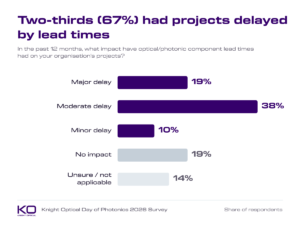
For some organisations, the consequences extend beyond development schedules. More than a quarter of respondents (29%) said component availability had delayed or prevented a product or system launch within the past two years.
A single late component can affect an entire project. Whether it is a lens, filter, prism or detector, delays at component level often have knock-on effects throughout manufacturing, testing and commercialisation.
Engineers are adapting designs around availability
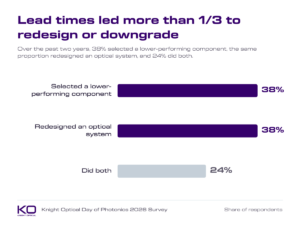
Perhaps the most notable finding from the survey is the extent to which availability is shaping technical decisions. Over the past two years, more than a third of respondents redesigned or downgraded because of lead times:
- 38% selected a lower-performing optical component because the preferred option was unavailable or carried an unacceptable lead time
- 38% redesigned an optical system because a required component could not be sourced in time
- 24% had done both
In addition, 57% said supply chain risk influenced engineering or design decisions either occasionally (43%) or frequently (14%). Only 5% said it had never done so, while 24% said it had rarely affected their decisions.
For many respondents, sourcing is now part of design. When a component can’t be delivered in time, engineers either accept a lower-performing alternative or change the design.
Capacity constraints are the main sourcing challenge
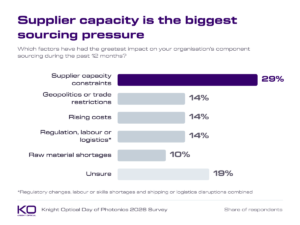
When asked what had most affected optical component sourcing over the past year, supplier capacity constraints emerged as the most common response, cited by 29% of participants.
Geopolitical tensions or trade restrictions, and rising costs, were the next most common, at 14% each.
Notably, every respondent who expressed low confidence in their supply chain identified supplier capacity as their greatest challenge.
Respondents also reported a range of consequences:
- 29% saw increased costs
- 19% experienced project delays
- 14% cited customer dissatisfaction as a consequence
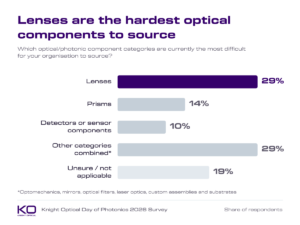
The survey also asked which optical components are proving most difficult to source.
Lenses were identified as the hardest category to obtain, with 29% of respondents selecting them. Prisms followed at 14%, while detectors and sensor components accounted for 10%. Mirrors, filters, laser optics, optomechanical components, custom assemblies and substrates were also mentioned.
Most organisations plan procurement over short timescales
Despite widespread concerns about availability, few organisations plan far ahead.
The survey found that:
- 71% plan less than six months ahead
- Only 10% plan seven to twelve months in advance
- Among those reporting major delays, three-quarters plan less than three months ahead
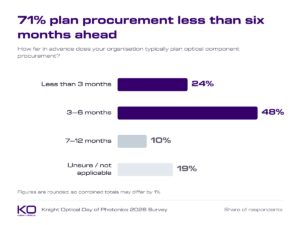
This may point to a link between shorter planning horizons and greater exposure to disruption.
Confidence in supply chain resilience was mixed. Almost half of respondents (48%) described themselves as fairly or very confident in their supply chain, while 38% were neutral or lacked confidence.
How organisations are responding
Companies are adopting a range of strategies to strengthen supply chain resilience.
The most common approach has been to broaden the supplier base, with a third of respondents (33%) adding alternative or additional suppliers.
Other measures included:
- Ordering further in advance (19%)
- Nearshoring or reshoring suppliers (19%)
- Increasing the use of stock components (19%)
- Establishing long-term supplier agreements (10%)
- Carrying additional stock (10%)
- Increasing supplier audits (10%)
Most respondents source primarily from Europe (48%), followed by North America (19%), China (14%) and the UK (10%).
Looking ahead, geopolitical instability was identified as the greatest long-term concern, selected by 38% of respondents. Raw material availability and rising costs followed at 29% each, while manufacturing capacity and export controls were each cited by 19%.
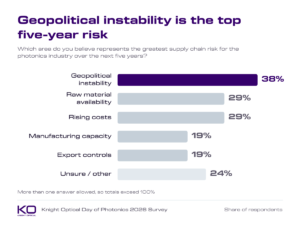
Many organisations are looking to reduce their reliance on a single supplier or source.
What the results mean
Across the survey, the results show that optical component availability is now an engineering concern as well as a procurement one.
More than a third of respondents had changed component selection or redesigned systems because required components were unavailable within project timescales. That suggests supply chain considerations are influencing decisions earlier in the design process.
For engineers, that may mean discussing component availability during system design rather than waiting until procurement begins. For purchasing teams, it reinforces the value of longer planning horizons for critical optical components.
Where performance requirements allow, standard catalogue products can sometimes reduce lead-time risk. Where custom optics are required, earlier engagement with suppliers may help identify manufacturing options before schedules become constrained.
How Knight Optical supports customers
We supply precision optical components, sub-assemblies and custom optical solutions, supporting customers from prototype through to production. Over 95% of the optics we supply are custom engineered for specific applications, backed by an extensive range of stock components for projects that need to move quickly.
Our team works with engineers, researchers and OEMs from the earliest stages of specification, helping identify whether a stock or custom component is the right route before schedules become constrained. Every component is checked in our dedicated metrology laboratory and through 100% quality assurance inspection, with a documented reject rate of just 0.015%.
If you are planning a new optical system or facing challenges with component availability, contact our team to discuss your requirements.
About the Survey
Knight Optical conducted its Day of Photonics 2026 survey to better understand how optical component availability is affecting engineering, manufacturing and procurement across the photonics industry.
The survey ran from 1 to 30 September 2026 and was promoted via the Knight Optical website, newsletter and LinkedIn page, and through advertising banners on industry media platforms. It was completed by 21 people working across the photonics industry. Participants who completed the survey were entered into a prize draw to win one of five Amazon vouchers.
Percentages are based on all respondents and are rounded, so totals may not equal exactly 100%. Some questions allowed respondents to select more than one answer.