
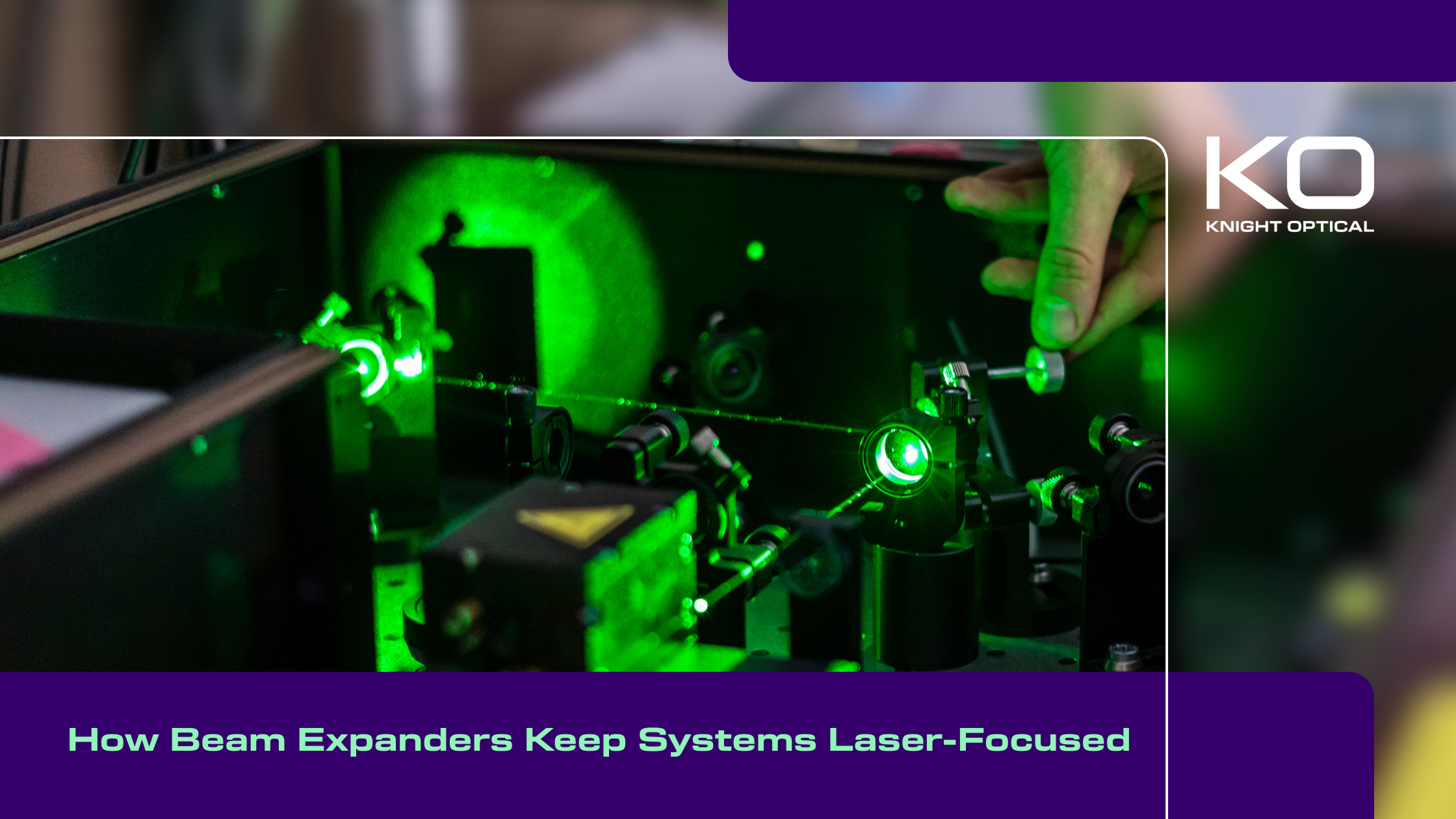
Whether it’s the barcode scanners you use at the checkouts during your weekly food shop or the laser processing devices that produce the metal parts in your car, beam expanders play a quiet yet crucial role in a variety of optical systems and laser technologies, improving efficiency and reliability. Here, we explain why they’re so important and how they operate.
Frequently found in lasers – although they also feature in numerous interferometry and imaging arrangements – beam expanders are integral to the optimal performance of many optical setups. This is due to their ability to take a narrow laser beam and expand it while keeping it controlled and parallel. For this reason, they’re highly popular in uses where a tighter focus is demanded (as wider beams can be focused into smaller spot sizes), cleaner cuts are needed – such as in laser-cutting processes – and more predictable behaviour is required.
How Beam Expanders Work
Typically made up of two lenses – or, in some cases, two mirrors – beam expanders are fundamentally based on the principles of a telescope, using the relationship between the two optical components to control beam enlargement. The first optic diverges the input beam, and the second recollimates the output beam, but at a larger diameter. Ultimately, the magnification depends on the ratio of the two focal lengths.
Different Types of Beam Expanders
There are two categories of beam expanders: Galilean and Keplerian. Although comparable in purpose, each has distinct characteristics that make it well-suited to different uses, enhancing the efficiency of laser technology.
Galilean Optical Design
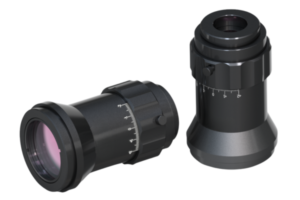
Based on the concept of the Galilean telescope, these variations are commonly utilised in high-power lasers, CO2 laser setups, LiDAR equipment and remote sensing. With one convex and one concave lens, Galilean designs – which are available from our stock catalogue of laser beam expanders – avoid internal focusing, which helps prevent the overheating and degradation that can occur in high-power operations.
Keplerian Variations
As their name suggests, these expanders work like a Keplerian telescope, with two convex lenses. They’re more common in laboratory or research settings where spatial filtering is often essential. While their fundamentals are similar to those of Galilean types, they converge the beam onto a point between the two lenses, where pinholes or apertures are typically positioned to filter out unwanted noise. This makes them particularly unsuitable for high-power lasers, where concentrated points could cause system damage.
The key difference is that Galilean beam expanders are usually chosen for compact, high-power applications, and Keplerian types are used for lower-power systems that require more precise filtering.
Although Keplerian designs are less widely stocked than Galilean varieties, they can be ordered in custom sizes via our bespoke optics service. To find out more, contact us today.
Beam Expanders from Knight Optical
With expansion ratios ranging from 2x to 12x and high transmission rates exceeding 98% – thanks to anti-reflective (AR) coatings – our Galilean beam expanders are optimised for use with 355nm solid-state lasers, making them ideal for UV applications.
With a high laser damage threshold, divergence adjustment and high pointing stability, they’re built for demanding environments where precision and reliability are non-negotiable.