
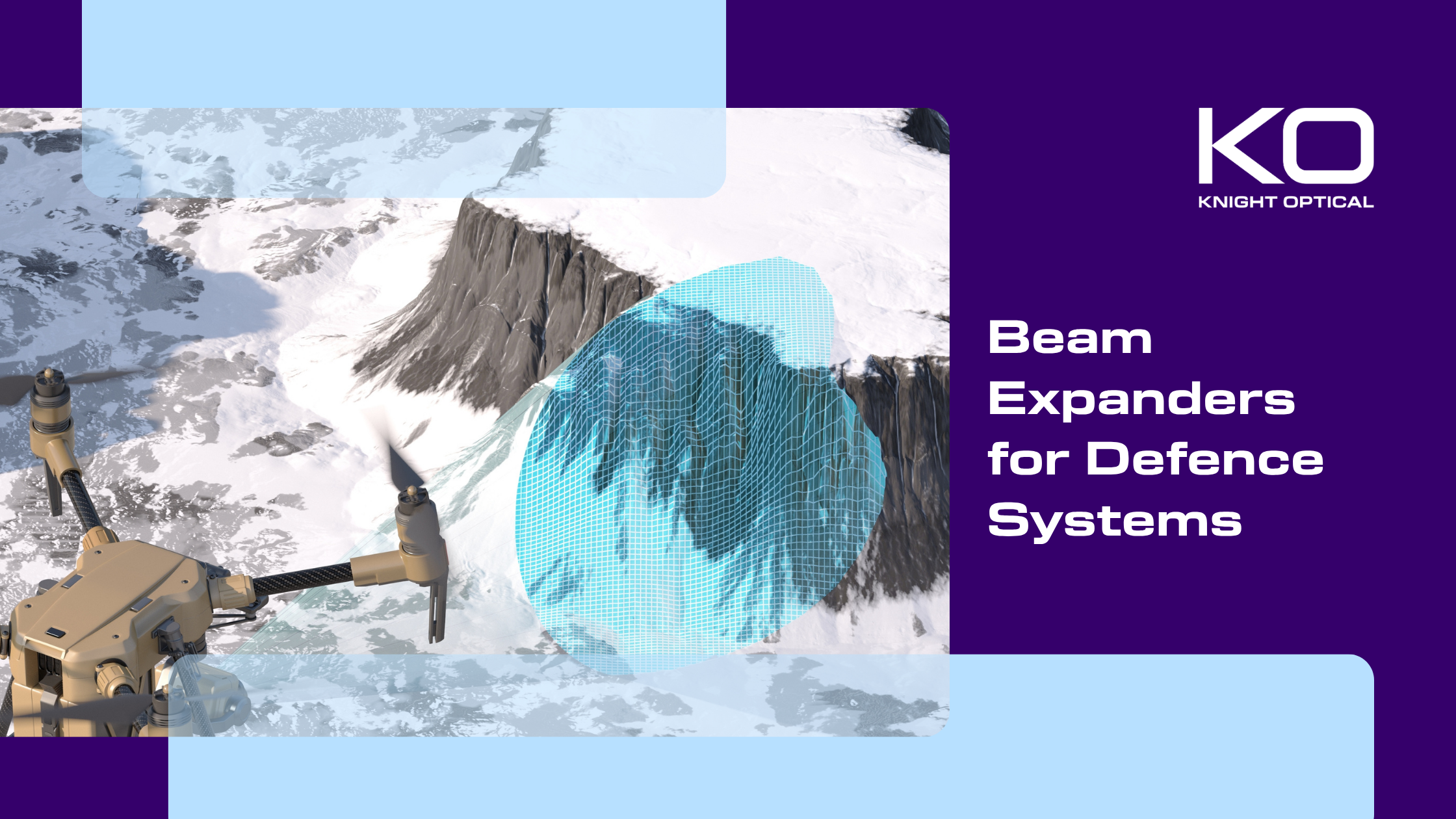
How Beam Expanders Enhance Laser Performance Across Defence Platforms
From laser rangefinders that measure distances for navigation and situational awareness to LiDAR for laser scanning, terrain mapping, obstacle avoidance, and remote sensing, beam expanders optimise the capabilities of laser technology across many defence platforms. However, their effectiveness is only as reliable as their optical setup. In this blog, we explore the components integrated into laser beam expanders and explain how their specifications shape system performance in defence‑grade laser applications.

There’s more to these optical assemblies than simply expanding beam diameter. In addition to reducing beam divergence – transforming a diverging beam and ensuring it remains tight over distance – they also collimate the beam to maintain a parallel path. Combined, these characteristics ensure that laser-based devices deliver consistent and dependable output when it matters most, resulting in a superior laser spot that, in defence settings, can be the difference between pinpoint accuracy and considerably costly errors.
The Optical Components Inside Beam Expanders
While optical design is a vital starting point, component specification is usually the stage at which capability can be won or lost within a beam expander. This includes physical optical elements like lenses – specified to the necessary focal lengths – and windows (sometimes used as protective covers), as well as optical coatings and material choices – all of which directly influence the final output.
Beam expanders come in two main optical designs – Keplerian and Galilean – and each requires specific lenses.
- Keplerian: with two positive lenses, Keplerian designs have an internal focal point where a spatial filter can be integrated for beam cleanup, resulting in better beam quality output. Here, plano-convex and bi-convex lenses as well as achromatic doublets are commonly specified.
- Galilean: using a positive and negative lens, Galilean types are more compact, with no internal focal point, making them preferred for high-power laser applications. Positive lenses, such as plano-convex lenses, are combined with negative lenses, such as plano-concave and bi-concave.
Anti-Reflection Coatings
Anti-reflection (AR) coatings are normally applied to lenses to minimise reflection, maximise transmission over the required spectral range, and keep laser beams as efficient as possible. In powerful configurations – for example, solid-state lasers, high-intensity diode laser designs, and short pulsed lasers – such losses can quickly add up and impair laser beam divergence, quality, and power.
Substrate Selection
Material choice is equally fundamental to beam performance. Different substrates perform more effectively in certain circumstances, for example:
- Fused silica lenses offer excellent thermal stability, low expansion, and a high optical damage threshold, making them a preferred option for high-powered systems, extreme temperatures and UV applications.
- N-BK7 (or equivalent) is a high-quality optical glass that’s a cost-effective option for platforms operating in less demanding environments.
- Sapphire is extremely hard and scratch-resistant, rendering it ideal where mechanical durability is non-negotiable.
The Environmental Challenge Beam Expanders Face
These systems – and the expanders housed within them – operate under some of the harshest conditions, with multiple factors that can affect a setup, and, in some cases, cause failure.
For instance, extreme thermal conditions can trigger expansion and contraction, ultimately affecting alignment, output, and beam divergence. Vibration is another common occurrence, which can misalign optics, such as lenses. Dust and other contaminants can also degrade optical quality over time, particularly on exposed components like windows.
Watch: Beam Expanders
To find out more about beam expanders watch our video below, and be sure to visit our YouTube channel and subscribe for more videos on optical components and how they’re utilised by some of the world’s morst critical industries.
Knight Optical’s Components for Beam Expanders
Working with a trusted optical component supplier ensures specifications are met for project-specific demands, lead times are fulfilled, and bespoke requirements can be accommodated.
At Knight Optical, our in-house, ISO 9001:2015-certified metrology laboratory verifies everything from transmission and centration to lens figure. Coupled with our dedicated quality assurance department – which works to MIL-SPEC standards – and our ITAR-registered facilities, this verification is invaluable for OEMs needing to ensure quality and performance across defence markets.
To find out more about our stock and custom-made optical components for beam expanders, contact a member of our technical sales team today.