

Cold Mirrors & Their Optical Function
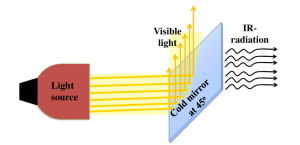
Cold mirrors –a type of heat control filter– are optical components that manage both visible and infrared (IR) light within a system. Their design allows them to reflect visible wavelengths while transmitting infrared radiation away, helping to reduce heat without affecting optical performance.
How Cold Mirrors Work
Cold mirrors are typically coated with a dichroic coating that determines their reflective and transmissive behaviour. When positioned at a 45° angle of incidence, the mirror reflects visible light while transmitting IR.
This makes them particularly useful in systems where heat generated by infrared radiation could interfere with performance or damage sensitive components.
Optical Principles
The effectiveness of a cold mirror lies in the thin-film interference of its coating layers. By carefully controlling the thickness and refractive index of these layers, manufacturers can define the cut-off point between reflected and transmitted wavelengths.
- Visible range (approx. 400–700nm): reflected
- Infrared range (typically >700nm): transmitted
This controlled separation of light is what categorises cold mirrors as dichroic filters, as they divide light based on wavelength.
Applications of Cold Mirrors
Because they separate visible light from IR radiation, cold mirrors are widely used in:
- Projection systems – maintaining bright visible output while directing heat away.
- Lighting design – from stage and studio lighting to architectural installations, where controlling colour and temperature is important.
- Scientific and medical instruments – preventing thermal interference in sensitive optical assemblies.
- Imaging systems – improving stability by reducing unwanted IR.
- Heads up Displays
Knight Optical and Cold Mirrors
Knight Optical offer off-the-shelf cold mirrors in a range of dimensions, with custom dimensions available with a fast turnaround.
Our cold mirrors offer the following spectral characteristics when used at 45°:
R(avg) > 95% @ 425-650nm
T(avg) > 85% @ 800-1200nm
Summary
Cold mirrors are essential components in systems where managing heat and visible light simultaneously is critical. By reflecting visible wavelengths while transmitting IR, they enable designers to maintain optical clarity and brightness without the risk of thermal build-up.
Their function is based on precise thin-film coatings that control wavelength behaviour, making them a reliable choice across projection, lighting, and scientific applications.